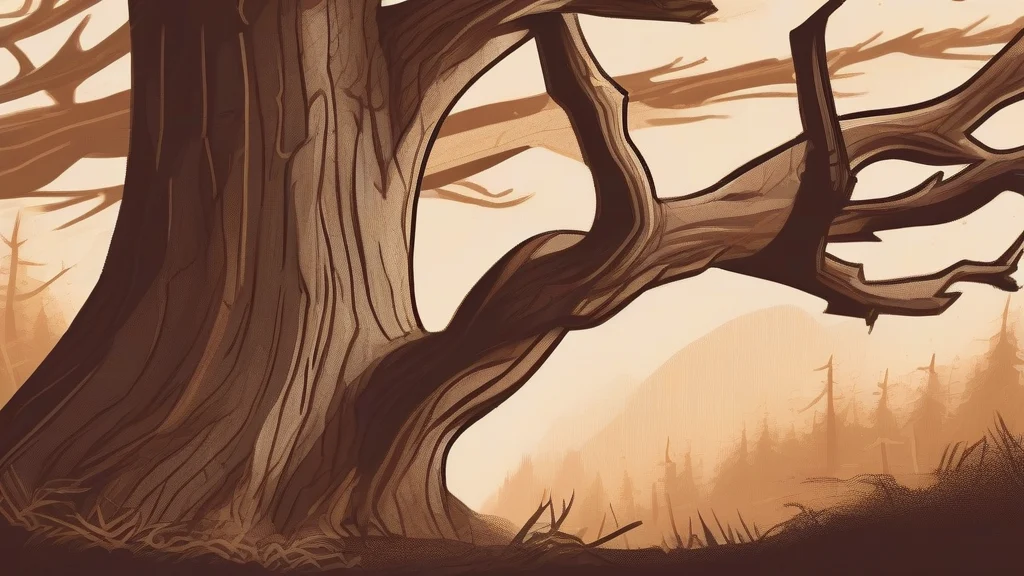
What does bark mean?
"Bark" is an unusual word because it combines two entirely distinct meanings under one spelling. Most familiarly, it is the sharp, explosive cry made by a dog — and by extension any abrupt, harsh vocal outburst, including a person barking commands. Separately, bark is the tough, protective outer layer of a tree's trunk and branches, serving as armor against cold, insects, and disease; economically important products such as cork and cinnamon are harvested from it. As a verb, bark describes the act of making that canine cry or shouting sharply at someone. There is also an older, now rare nautical meaning: a bark was a small sailing ship, surviving today mainly in the spelling "barque." Curiously, the animal and tree meanings have different historical origins that converged on the same written form. The word is common, versatile, and appears in idioms such as "barking up the wrong tree," meaning to pursue a mistaken course of action.
The sharp, harsh cry of a dog; also, the tough outer covering of a tree's trunk and branches; also (dated) a small sailing vessel.
"The dog gave a single warning bark at the stranger at the gate."
In the tree sense, bark is treated as an uncountable mass noun; in the animal sense it is countable.
To make a sharp, harsh cry like a dog; to shout abruptly and harshly at someone.
"The drill sergeant barked orders across the parade ground."
Figurative use for people implies short, aggressive speech rather than sustained yelling.
Applies to the countable senses — individual dog cries or dated sailing vessels. Tree bark, being a substance, is not normally pluralized.
"We could hear excited barks coming from the kennel next door."
"Bark" is really two unrelated words in one: the dog sound comes from Old English, while tree bark was borrowed from the Vikings — they just happened to collide into a single spelling.
Reviewed by Deb Chak, Editor. AI-assisted content curated by RJS Tech Solutions LLP.
Etymology of bark
The two main senses of "bark" come from different sources that merged in form. The dog-cry sense descends from Old English "beorcan," meaning to growl or bay, and is native Germanic vocabulary shared with related words in other Germanic languages. The tree-bark sense entered Middle English from Old Norse "bǫrkr," the Scandinavian term for a tree's outer covering, during the period of Viking influence on northern England. The nautical sense of bark as a small ship has yet another origin, ultimately traceable through medieval Latin and Romance forms, and survives chiefly as "barque." Because these strands are historically distinct, there is no single shared root linking all uses of the modern word.
Related word forms
How bark is actually used
As a verb, "bark" applies most naturally to dogs and other canids, but it is also used figuratively for people who speak in short, sharp bursts (e.g. a sergeant barking orders). The tree-covering sense is uncountable in ordinary usage. The nautical sense is now rare and largely replaced by "barque." Note that "bark" as a dog sound and "bark" as tree covering are historically unrelated words that merged in spelling.
Easily confused with bark
A barque is a type of sailing ship with three or more masts, whereas bark refers either to a dog's sound or to a tree's outer layer.
"Berk" is British slang for a foolish person, while "bark" means a dog's cry or a tree's outer covering.