What does barnyard mean?
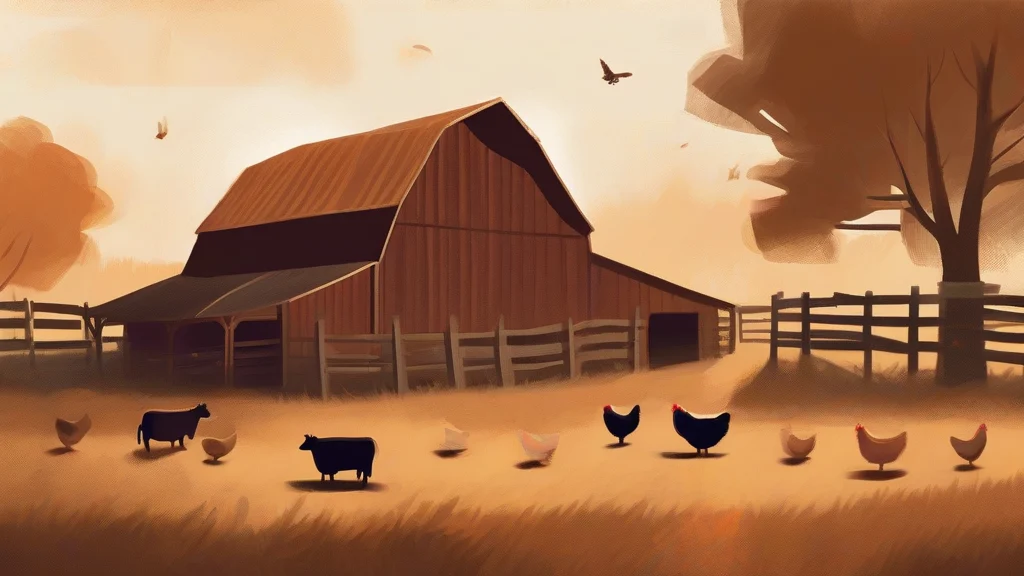
A barnyard is the open area of ground surrounding a barn on a farm, usually fenced or enclosed, where livestock such as chickens, pigs, and cattle are kept and where much of the daily work of the farm takes place. It is a practical, working space — scattered with feed, straw, and the comings and goings of animals — and it has long served as a symbol of rural life in literature and speech. Beyond this literal meaning, barnyard frequently appears as an adjective describing things connected with farms or farm animals ('barnyard animals'), and by extension it can suggest rustic coarseness, as in 'barnyard humor,' meaning jokes that are earthy or crude. The word is a straightforward compound of 'barn' and 'yard,' two Old English elements, and it remains common in American English, though British speakers more often say 'farmyard.' Its connotations range from wholesome pastoral imagery to mild disapproval when applied to manners or language.
An area of open ground adjacent to a barn, typically enclosed, where farm animals are kept and outdoor farm work is carried out.
"Every morning she opened the gate and let the geese wander out into the barnyard."
Frequently used attributively before another noun, as in 'barnyard animals' or 'barnyard smells.'
Characteristic of or associated with a barnyard; rustic, earthy, or crudely unsophisticated.
"The comedy relied heavily on barnyard humor that left half the audience wincing."
Always attributive in this sense; it never stands alone as a predicate adjective in standard usage.
Regular plural; used when referring to the yards of multiple farms or multiple separate enclosures.
"Roosters crowed from barnyards across the valley at first light."
The 'barn' in barnyard isn't about storage at all — it comes from an Old English word literally meaning 'barley house,' so a barnyard is, etymologically, a beer-ingredient backyard.
Reviewed by Deb Chak, Editor. AI-assisted content curated by RJS Tech Solutions LLP.
Etymology of barnyard
Barnyard is a compound of 'barn' and 'yard,' both inherited from Old English. 'Barn' descends from 'bern,' itself a contraction of 'bereærn,' meaning 'barley house' — a storehouse for barley — combining 'bere' (barley) and 'ærn' (building). 'Yard' comes from Old English 'geard,' meaning an enclosure or dwelling area, cognate with 'garden.' The compound emerged in Middle-to-early Modern English as farming settlements organized space around their barns.
How barnyard is actually used
Mostly used in literal rural contexts, but the attributive sense (especially 'barnyard humor') carries a mildly negative connotation of coarseness or vulgarity. In British English, 'farmyard' is more common for the physical space.
Easily confused with barnyard
A farmyard is the general yard area around a farmhouse and its buildings, while a barnyard specifically refers to the ground immediately around a barn where livestock are kept.