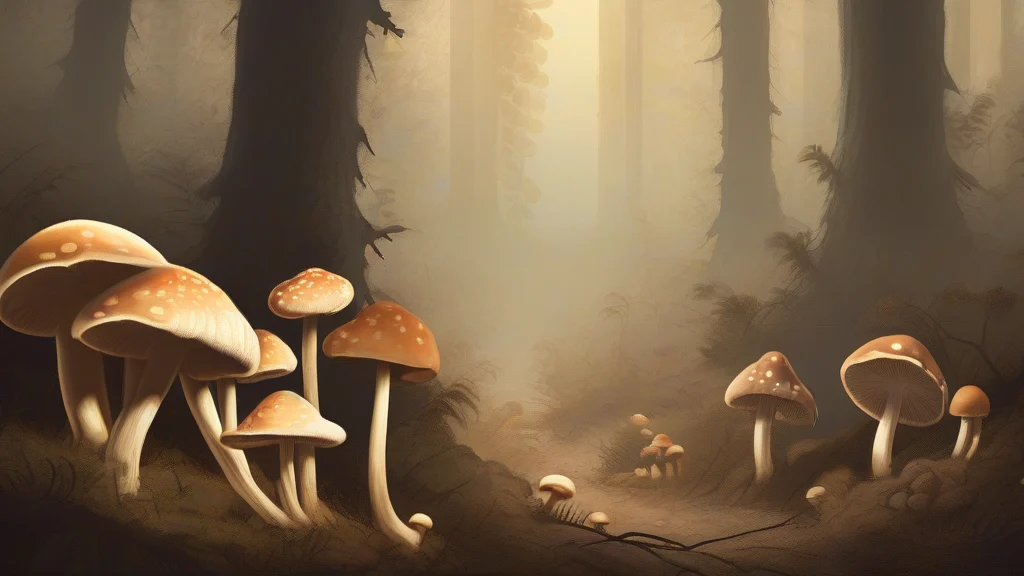
What does basidiomycete mean?
A basidiomycete is any member of Basidiomycota, one of the two largest divisions of the fungal kingdom. These fungi are defined by their mode of sexual reproduction: they produce spores called basidiospores on the outer surface of microscopic, club-shaped cells known as basidia. Familiar basidiomycetes include mushrooms and toadstools, along with puffballs, bracket or shelf fungi, jelly fungi, and the plant-pathogenic rusts and smuts. The visible mushroom is merely the reproductive fruiting body; the bulk of the organism exists as an often vast network of threads called hyphae, growing within soil, leaf litter, or wood. Some basidiomycetes are prized edibles, others are deadly poisonous, and many play essential ecological roles as decomposers or partners of tree roots in mycorrhizae. Because of their ecological importance and diversity — tens of thousands of species are known — basidiomycetes figure prominently in mycology, forestry, agriculture, and medicine.
nounAny fungus of the phylum (or subphylum) Basidiomycota, a large group that includes mushrooms, puffballs, bracket fungi, rusts, and smuts, characterized by producing sexual spores on the outside of club-shaped cells called basidia.
- A fungus belonging to the group Basidiomycota, distinguished by the production of sexual spores externally on basidia; includes mushrooms, toadstools, puffballs, shelf fungi, rusts, and smuts.
"The forest floor was dotted with basidiomycetes, their fruiting bodies pushing up through the leaf litter after the autumn rains."
"Rust diseases of wheat are caused by parasitic basidiomycetes that can devastate entire crops."
"Molecular studies have reclassified many basidiomycetes, revealing relationships invisible to the naked eye."
Standard English plural, formed by adding -es; used both informally and in scientific literature.
"Bracket fungi and chanterelles are both basidiomycetes found in temperate woodlands."
The mushrooms you see are just the tip of the iceberg — most of a basidiomycete lives hidden underground or inside wood, and some individuals spread across thousands of acres.
Reviewed by Deb Chak, Editor. AI-assisted content curated by RJS Tech Solutions LLP.
Etymology of basidiomycete
The word derives from Greek: 'basis' meaning base or pedestal, via 'basidium' — a diminutive coined for the club-shaped spore-bearing cell — combined with '-mycetes', from Greek 'mykes' meaning fungus. It entered scientific usage in the nineteenth century alongside the development of modern mycological classification.
Related word forms
How basidiomycete is actually used
A technical term used chiefly in mycology and biology; in everyday speech people simply say 'fungus' or 'mushroom.' The adjective 'basidiomycetous' is common in scientific writing. Stress falls on the third syllable.
Easily confused with basidiomycete
An ascomycete is a fungus in the other major fungal group (Ascomycota), whose sexual spores form inside sac-like cells called asci rather than on external club-shaped basidia.