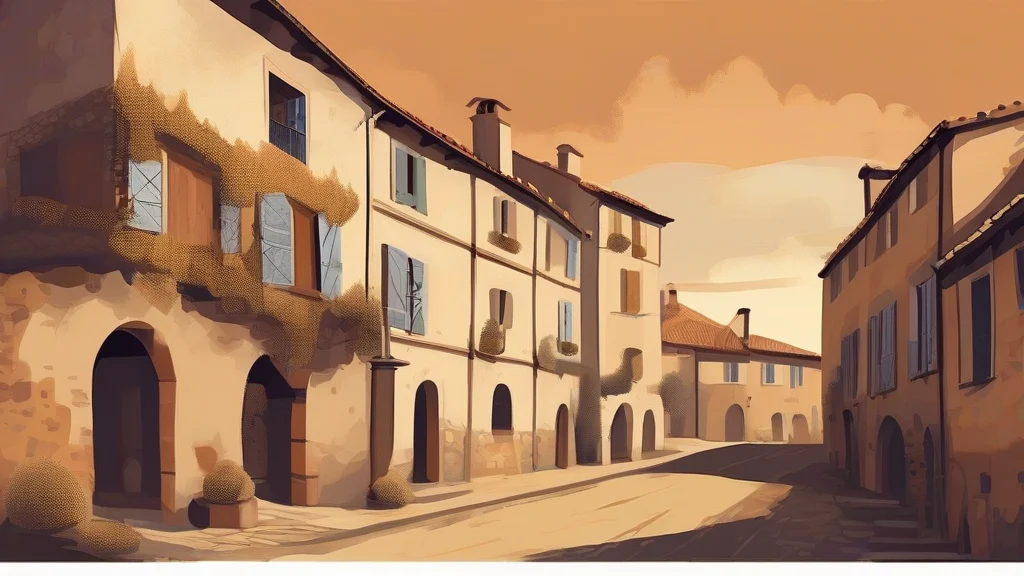
What does bastide mean?
A bastide is a type of planned, fortified town created in southern France — particularly the southwest — chiefly during the thirteenth and fourteenth centuries. Unlike organically grown villages, bastides were deliberately laid out, often by feudal lords competing for territory and trade, on regular grid patterns centered on a marketplace, frequently framed by stone arcades. Towns such as Monpazier, Villeneuve-sur-Lot, and Auvillar remain strikingly intact examples, making the term familiar to travelers, historians, and architecture enthusiasts alike. In modern usage, especially in tourist writing about Provence, the word also denotes a grand country house or farmhouse estate, reflecting a separate regional tradition. Though somewhat specialized, 'bastide' is a precise and evocative term that captures a distinctive chapter in European urban history: the moment when medieval rulers applied rational, geometric planning to new settlements, leaving behind some of the most coherent and charming townscapes in France.
A planned fortified town built in medieval southern France on a regular grid pattern, typically with a central market square.
"Founded in 1284, Monpazier is considered one of the finest surviving bastides in France."
Often qualified by terms like 'bastide town' or 'medieval bastide' in travel and historical writing.
A large country house or estate in Provence, often converted into a residence or hotel.
"The couple rented a seventeenth-century bastide surrounded by olive groves for their summer stay."
This sense is specific to Provençal usage and is common in tourism literature.
Standard English plural; the word is normally countable when referring to multiple towns or estates.
"The guidebook listed over a dozen bastides within easy driving distance of Toulouse."
Medieval France's bastides were so precisely grid-planned that their central market squares still anchor hundreds of towns today — urban planning 700 years ahead of its time.
Reviewed by Deb Chak, Editor. AI-assisted content curated by RJS Tech Solutions LLP.
Etymology of bastide
Bastide comes ultimately from the Latin verb 'bastire', meaning to build or construct, which passed into Old Provençal (Occitan) as 'bastir'. The word originally referred to building works and later came to denote the fortified towns themselves, many founded under treaties between French and English kings in contested Aquitaine. It is related etymologically to words like 'bastion' and 'bastille', which share the same root idea of construction and fortification.
How bastide is actually used
Primarily used in architectural history, travel writing, and discussions of French heritage. The 'Provençal country house' sense is common in tourism contexts but distinct from the historical town-planning sense; context usually makes clear which meaning is intended. The word is relatively formal and specialized in English.
Easily confused with bastide
A bastille is a fortress or prison (most famously the Parisian one stormed in 1789), whereas a bastide is a planned fortified town or a Provençal country house.
A bastion is an individual projecting part of a fortification wall, while a bastide is the entire planned settlement itself.