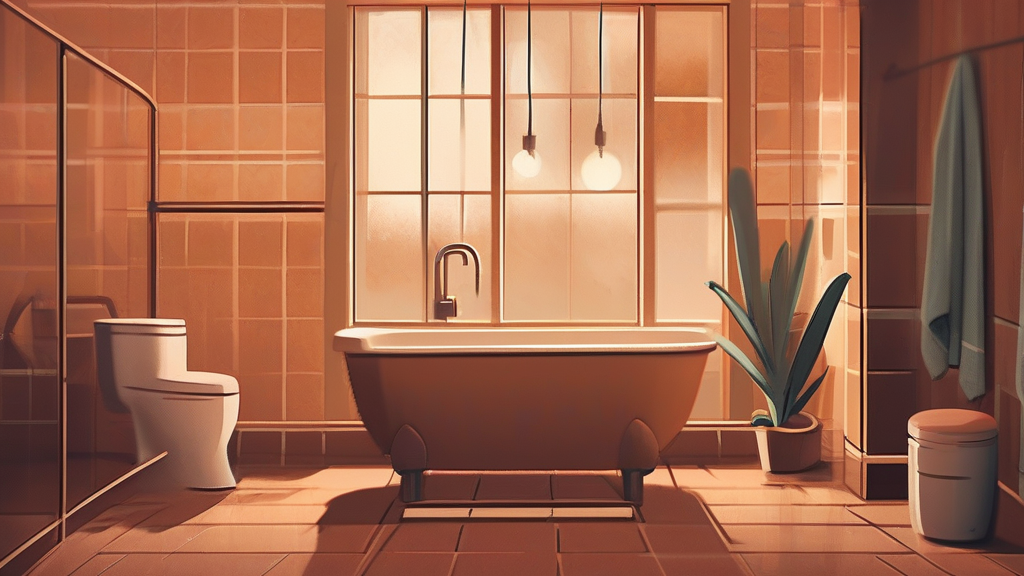
What does bathroom mean?
A bathroom is a room equipped for personal hygiene, most characteristically containing a bathtub or shower along with a sink and usually a toilet. It is one of the standard rooms of a modern dwelling, alongside the kitchen and bedrooms, and its design and upkeep carry considerable cultural weight — bathrooms feature prominently in home renovation, real-estate listings, and interior design. The word also functions as a polite euphemism, particularly in American English, where asking to "use the bathroom" means needing the toilet regardless of whether bathing fixtures are nearby. British speakers tend to reserve "bathroom" for rooms that actually contain a bath or shower, using "toilet" or "loo" for the fixture itself. Derived from "bath" plus "room," the term reflects how domestic spaces became specialized over the past two centuries: indoor plumbing transformed what was once a shared, occasional activity into a private daily ritual, making the bathroom one of the most intimate and frequently used rooms in the home.
A room containing a bathtub or shower, and typically a toilet and sink, used for washing and personal hygiene.
"The apartment has two bedrooms and a spacious modern bathroom."
In American English, often used euphemistically to refer to the toilet itself, as in "going to the bathroom."
A public toilet or lavatory facility, especially in American usage.
"The service station's bathrooms were surprisingly clean."
Regular plural formation; used when referring to multiple such rooms, e.g., in buildings or property descriptions.
"The house has three bedrooms and two full bathrooms."
In American real estate, the number of bathrooms can add more to a home's value than an extra bedroom — proof that this humble room carries serious weight.
Reviewed by Deb Chak, Editor. AI-assisted content curated by RJS Tech Solutions LLP.
Etymology of bathroom
The word "bathroom" is a straightforward compound of two native English elements: "bath," from Old English "bæþ," meaning immersion or washing in water, and "room," from Old English "rūm," meaning an enclosed space. Both roots trace back through Proto-Germanic, making "bathroom" a thoroughly Germanic formation rather than one borrowed from Latin or Greek. The compound arose in the nineteenth century as indoor plumbing made dedicated bathing rooms a fixture of middle-class homes, and it quickly spread throughout the English-speaking world, developing its American euphemistic use for toilets along the way.
How bathroom is actually used
In American English, "bathroom" commonly serves as a euphemism for the toilet itself, as in "I need to go to the bathroom," even when no bathing facilities are present. In British English, "bathroom" specifically implies a room with a bath or shower; Britons would say "loo" or "toilet" instead. In real-estate contexts, a room with only a toilet and sink may be called a "half bath" rather than a full bathroom.
Easily confused with bathroom
A restroom refers only to a public toilet facility without bathing fixtures, whereas a bathroom includes a tub or shower and typically implies a private, residential setting.