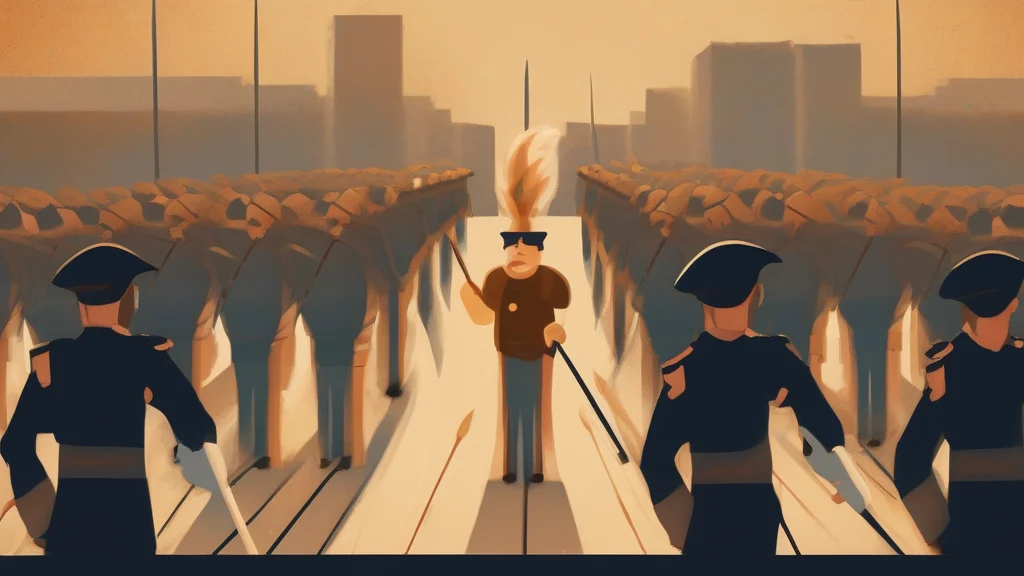
What does baton mean?
A baton is a short, slender stick with a surprising range of specialized uses. Most elegantly, it is the thin wand a conductor raises to lead an orchestra; most athletically, it is the cylinder relay runners exchange in a race; most functionally, it is the staff a police officer carries for defence or crowd control. Drum majors and majorettes twirl showier versions in parades. Beyond these literal senses, 'baton' has become one of English's most durable metaphors: to 'pass the baton' means to hand over responsibility, leadership, or a cherished tradition to someone else. The word entered English from French in the sixteenth century, ultimately tracing back through Latin 'bastum' to Greek, and it remains firmly standard in both British and American usage. Its connotations are generally positive — authority gracefully exercised, or duty honourably transferred — making it a vivid, precise choice whenever continuity between people matters more than any single individual.
nounA baton is a short, slender stick carried by a conductor, drum major, police officer, or relay runner, each use carrying its own specialized meaning. It also figuratively denotes a duty, responsibility, or leadership role passed from one person to another.
- A light rod used by a musical conductor to direct an orchestra.
- A short staff carried as a symbol of office or used as a weapon (e.g. a police officer's baton or truncheon).
- A hollow cylinder passed between runners in a relay race.
- A stick twirled by a drum major or majorette.
- Figuratively: a duty, role, or tradition handed on from one person to another.
"The conductor raised her baton and the orchestra fell silent."
"With a flick of his baton, the conductor brought the strings to a hush."
"After thirty years at the helm, she finally passed the baton to her successor."
Standard regular plural; used when referring to multiple sticks or to several instances of the metaphorical handover.
"The equipment box held spare batons for every leg of the relay."
In a relay race the baton must change hands within a 20-metre zone — drop it and the whole team is disqualified, which is why 'passing the baton' became the world's favourite metaphor for handing over responsibility.
Reviewed by Deb Chak, Editor. AI-assisted content curated by RJS Tech Solutions LLP.
Etymology of baton
Baton entered English in the mid-sixteenth century, borrowed directly from French bâton meaning 'stick' or 'staff'. The French word descends from Old French 'baston', which itself came from Late Latin 'bastum', a term of uncertain deeper origin that some scholars connect to Greek 'bastazein' ('to carry'). The same Latin root gave rise to related English words including 'batten' (originally a fattening board, later a supporting strip) and the archaic verb 'baste'. The word has retained its core sense of a hand-held stick throughout its history, with each modern use — conducting, policing, relay racing — developing from that simple original meaning.
How baton is actually used
The plural 'batons' is standard. In British English the police weapon sense often takes the form 'truncheon', while American English favours 'nightstick' or simply 'baton'. The figurative sense almost always appears in the fixed phrase 'pass the baton' and carries a positive connotation of continuity and succession.
Easily confused with baton
A batten is a long strip of wood or metal used to fasten or support something, whereas a baton is a short stick carried by hand for conducting, signalling, striking, or passing in a relay.