
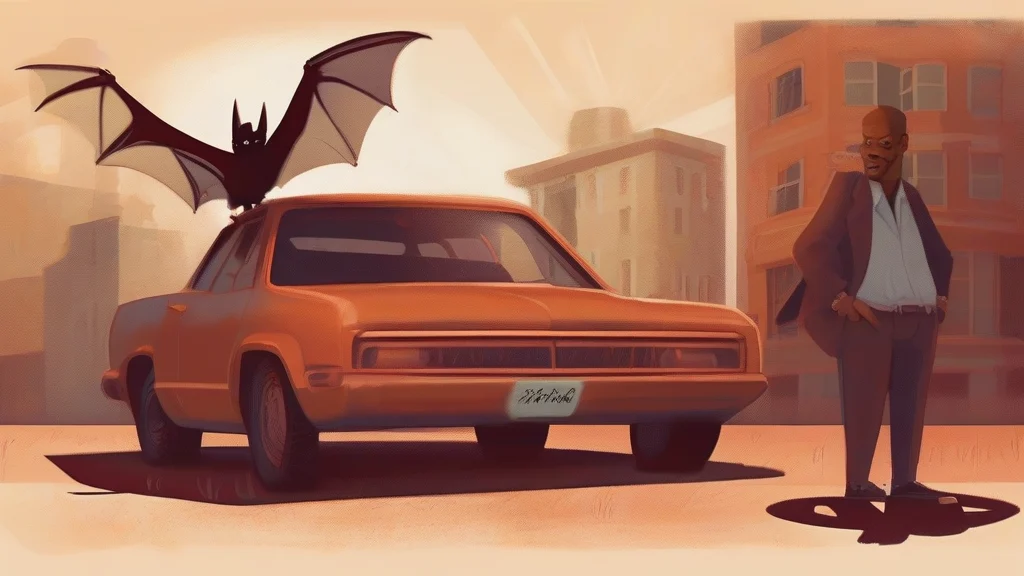
What does battier mean?
"Battier" is the comparative form of the informal adjective "batty," which describes someone or something as eccentric, irrational, or mildly crazy. To say that one idea, plan, or person is battier than another is to say it displays a greater degree of harmless madness or absurdity. The word belongs firmly to casual register: it appears in everyday conversation, humor writing, and light journalism rather than formal or clinical contexts, where terms such as "irrational" or "delusional" would be preferred. Its connotation is generally playful and affectionate — describing an endearingly odd uncle or an increasingly outlandish theory — rather than harsh or stigmatizing. The underlying term "batty" emerged in the nineteenth century, most plausibly inspired by the erratic flight of the bat, and it pairs naturally with expressions like "going batty." "Battier" is useful precisely because it allows gradations of craziness: things can grow battier over time, or one notion can be judged battier than another.
adjectiveComparative form of "batty": more eccentric, crazy, or slightly insane than something else.
- More eccentric, irrational, or mildly insane than something else (comparative of "batty").
"Every year his conspiracy theories grew battier, until even his closest friends stopped arguing with him."
"As the deadline approached and sleep became scarce, her plans grew steadily battier."
"Of all the excuses he'd offered over the years, this one was easily the battier."
The slang term "batty" likely owes its meaning to the erratic, darting flight of the bat — so calling an idea battier literally compares it to a creature flying wildly in the dark.
Reviewed by Deb Chak, Editor. AI-assisted content curated by RJS Tech Solutions LLP.
Etymology of battier
"Battier" derives from "batty," a British and American slang adjective first recorded in the late nineteenth century. The term is widely thought to originate from the bat, whose swift, erratic flight suggested mental instability, though some sources connect it instead to the dialect word "batty" meaning a butter churn or to the phrase "bats in the belfry." Whatever its precise trigger, "batty" settled into common use as a mild synonym for "crazy," and "battier" arose as its ordinary comparative inflection, formed with the suffix "-er."
Related word forms
How battier is actually used
Informal and colloquial in both British and American English; carries a lighthearted, often affectionate connotation rather than a clinical one. As a comparative adjective, it typically appears before "than" or in progressive descriptions of escalating oddness.
Easily confused with battier
"Battier" means more crazy or eccentric, while "better" means improved or superior — they sound similar but are entirely unrelated in meaning.