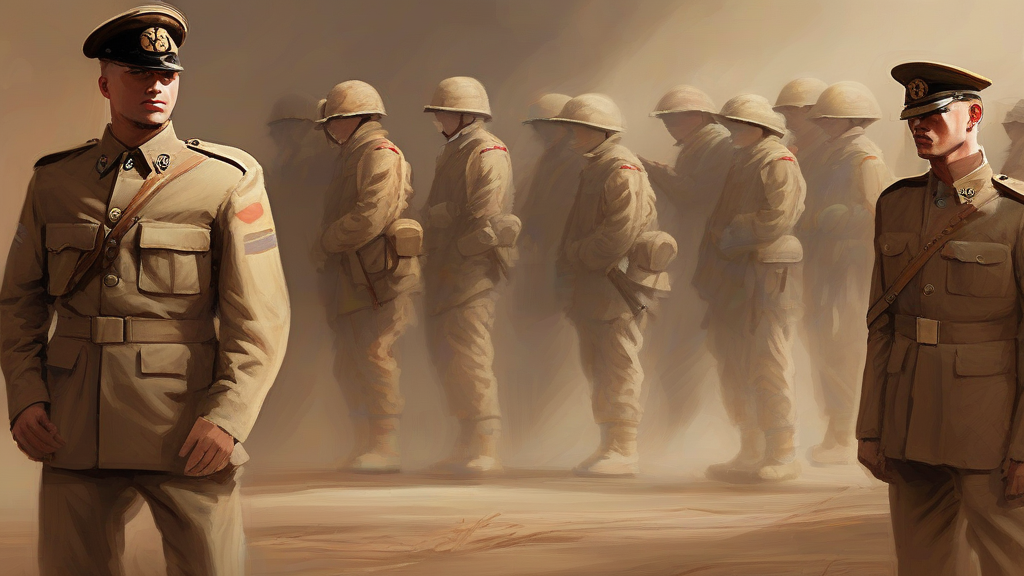
What does battledress mean?
Battledress is a noun denoting the uniform a soldier wears in the field or in combat, as opposed to the formal attire reserved for parades and ceremonies. Although the idea of practical fighting clothes is ancient, the word is most closely identified with the British Army's khaki two-piece service uniform introduced just before the Second World War, whose short blouse and loose trousers were designed for ease of movement and durability under fire. Worn by millions of British and Commonwealth troops throughout the war, it became an enduring symbol of that generation's service, and surviving examples are now prized by collectors and museums. The term carries connotations of practicality, hardship, and frontline experience rather than pomp, and it appears frequently in memoirs, regimental histories, and archival captions. For readers of military history, understanding battledress helps distinguish the everyday working clothes of soldiers from the ceremonial uniforms more often seen in official portraiture.
nounA military uniform designed for wear in combat or field conditions, as distinct from formal or ceremonial dress. The term is especially associated with the standard British Army service uniform introduced in the late 1930s and worn through the Second World War.
- A military uniform worn for combat or field duty, as opposed to ceremonial or formal dress; especially the British Army's khaki service uniform introduced in 1937.
"The veterans arrived at the ceremony in their wartime battledress, medals pinned to their chests."
"Photographs from Normandy show the infantrymen in creased, mud-spattered battledress."
"He kept his father's Second World War battledress carefully folded in an old cedar chest."
The plural is rare, since the word usually refers to the type of garment collectively rather than individual items; it appears mainly when counting distinct sets or specimens.
"The quartermaster issued fresh battledresses to all new recruits before the inspection."
The British Army's 1937 battledress was so radical a departure from parade-style uniforms that some senior officers initially dismissed it as looking like civilian workwear — yet it became one of the most influential military garments of the twentieth century.
Reviewed by Deb Chak, Editor. AI-assisted content curated by RJS Tech Solutions LLP.
Etymology of battledress
Battledress is a straightforward English compound formed from 'battle' and 'dress'. The element 'battle' derives from Old French 'bataille', itself from Vulgar Latin forms based on Latin 'battuere' ('to beat'), making it cognate with words such as 'combat', 'batter', and 'abate'; 'dress' comes through Old French 'drecier' from Frankish origins, related to 'direct' and 'address'. The compound arose in English military vocabulary in the late nineteenth century as armies began distinguishing field clothing from parade uniform, and it gained its strongest association when the British Army adopted its 1937-pattern service dress specifically for combat use.
How battledress is actually used
Battledress is primarily a military-historical term, most strongly associated with British and Commonwealth forces of the mid-twentieth century. It is often written hyphenated as 'battle-dress' in older texts, though the unhyphenated form is now standard. In American usage the equivalent concept is more often expressed as 'fatigues' or 'combat uniform', making 'battledress' sound distinctly British to many ears.
Easily confused with battledress
Dress uniform is the formal, ceremonial attire worn on parade occasions, whereas battledress is the practical field clothing intended for combat or active service.