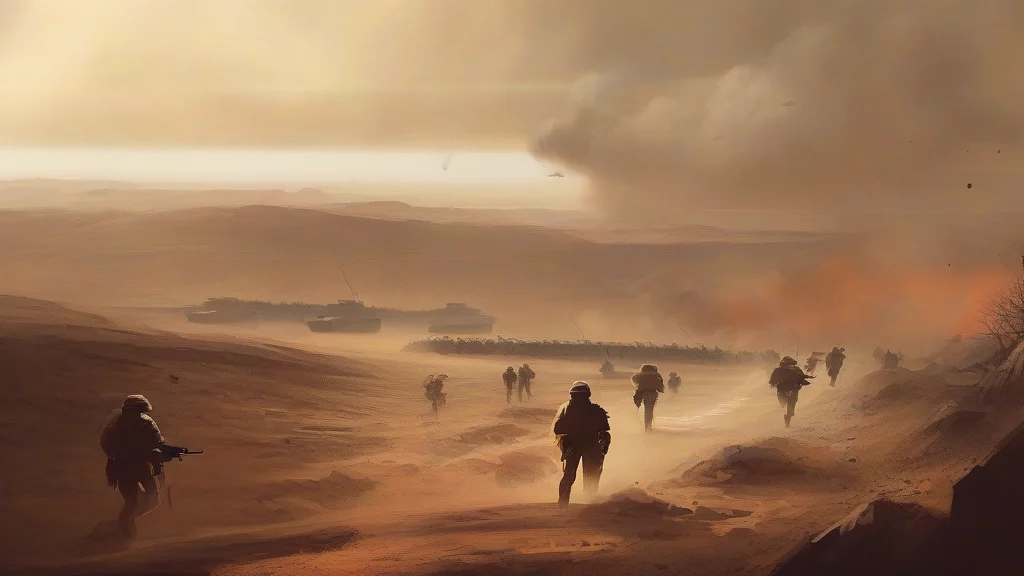
What does battlefront mean?
A battlefront is the line or region along which opposing armed forces are actively engaged in combat — the shifting edge where a war is actually being fought, as distinct from supply lines, headquarters, or the home front. The term became especially prominent during the twentieth century's world wars, when conflicts stretched across vast fronts, and phrases like 'opening a new battlefront' or 'fighting on two battlefronts' entered common strategic vocabulary. In modern usage it also extends metaphorically to non-military struggles: public health campaigns, legal battles, or social movements may each be described as a battlefront in a larger cause. The word conveys intensity, urgency, and sustained conflict, and it appears most often in news reporting, historical writing, and political rhetoric. Its power lies in evoking not a single clash but an ongoing, contested boundary between opposing sides.
nounThe area or line along which opposing armies or forces are engaged in combat; the zone of active fighting in a war. By extension, it can refer to the leading edge of any struggle or campaign, such as a fight against disease or social injustice.
- The line or area along which opposing military forces are actively engaged in combat.
- Figuratively, the leading edge of any sustained struggle or campaign, such as against disease, poverty, or injustice.
"Thousands of soldiers were stationed along the eastern battlefront throughout the winter."
"Reports from the northern battlefront described weeks of relentless artillery exchanges."
"Researchers see vaccination campaigns as a crucial battlefront in the fight against malaria."
The plural typically refers to several distinct zones of combat within the same war, as when a nation fights on multiple fronts simultaneously.
"By 1943, Germany was defending battlefronts in the east, the south, and the west."
In both World Wars, opening a 'second battlefront' was such a decisive strategic goal that entire nations' fates hinged on where — and when — a new one could be launched.
Reviewed by Deb Chak, Editor. AI-assisted content curated by RJS Tech Solutions LLP.
Etymology of battlefront
Battlefront combines 'battle,' from Old French 'bataille' (ultimately from Late Latin 'battualia,' meaning exercises of fighting), with 'front,' from Latin 'frons' via Old French 'front,' denoting the foremost part or face of something. As a compound, it emerged in English in the context of modern industrial warfare, gaining wide currency during the First World War when static lines of combat stretched for hundreds of miles. Related words sharing the 'battle' root include battalion, battery, and combat.
How battlefront is actually used
Battlefront carries a serious, often somber register and appears chiefly in journalism, history, and military writing. The figurative sense (e.g., 'a battlefront against climate change') is common in political and advocacy rhetoric but can sound grandiose if overused. Plural use typically implies simultaneous fronts in different theaters of a war.
Easily confused with battlefront
The home front refers to civilian life and activity in a nation at war, while the battlefront is the actual zone where armed forces are fighting.
A battlefield is the specific site of a single engagement, whereas a battlefront is the broader extended line or area along which combat occurs over time.