
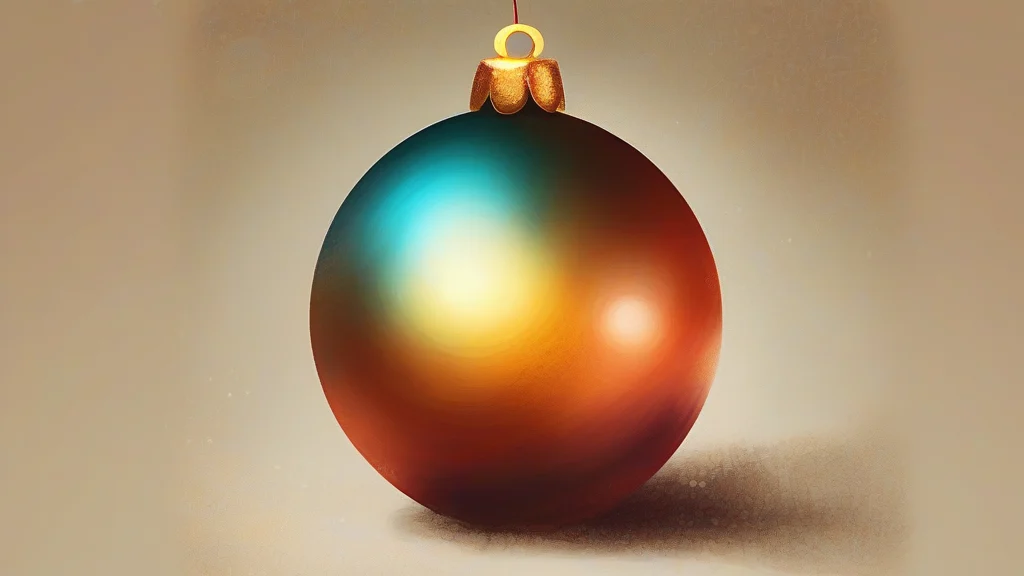
What does bauble mean?
A bauble is a small, showy object of little real value — a trinket whose appeal lies entirely in its glitter rather than its substance. The word typically carries a dismissive or condescending tone: a critic might call a trophy, a piece of costume jewelry, or a gaudy souvenir a mere bauble to suggest it is superficial or worthless. In British English, however, the word has an entirely benign and festive second life as the standard term for the colorful ball ornaments hung on a Christmas tree, where 'Christmas baubles' are a cherished part of seasonal decoration. Derived through Old French, the word has been part of English since late medieval times. Its enduring usefulness lies in this contrast: whether describing hollow pomp or holiday cheer, a bauble is always something lovely to look at but light in worth.
nounA small, showy trinket or piece of jewelry that is cheap or of little value; in British English, specifically a brightly colored ball ornament hung on a Christmas tree.
- A small, cheap, showy trinket or ornament of little intrinsic value.
- (British English) A decorative ball hung on a Christmas tree.
"She dismissed the award as a mere bauble that meant nothing to her."
"The market stall was crammed with glittering baubles and costume jewelry."
"They spent December evenings decorating the fir with red and gold baubles."
Standard regular plural; most often encountered in the Christmas-ornament sense.
"The box of glass baubles had been in the family for generations."
In Britain, 'bauble' isn't an insult at all — it's the beloved word for those shiny balls you hang on the Christmas tree.
Reviewed by Deb Chak, Editor. AI-assisted content curated by RJS Tech Solutions LLP.
Etymology of bauble
The word entered English in the late Middle Ages from Old French 'baubel', meaning a trinket or child's toy, though the ultimate origin of the French word remains uncertain. It has carried its sense of a cheap, showy plaything since earliest recorded use in English, appearing in medieval literature to describe trifling ornaments. Because its deeper ancestry is obscure, few secure cognates exist in other languages.
How bauble is actually used
The word almost always carries a connotation of worthlessness or superficiality when applied to possessions or honors, so it can sound dismissive. In British usage around the holidays, however, it is neutral and affectionate. Slightly literary or formal in register outside the Christmas context.
Easily confused with bauble
A bobble is a small fluffy ball, typically on a hat, whereas a bauble is a showy trinket or Christmas-tree ornament.
A bubble is a sphere of gas or liquid, unrelated in meaning, but its similar spelling leads to occasional typos for 'bauble'.