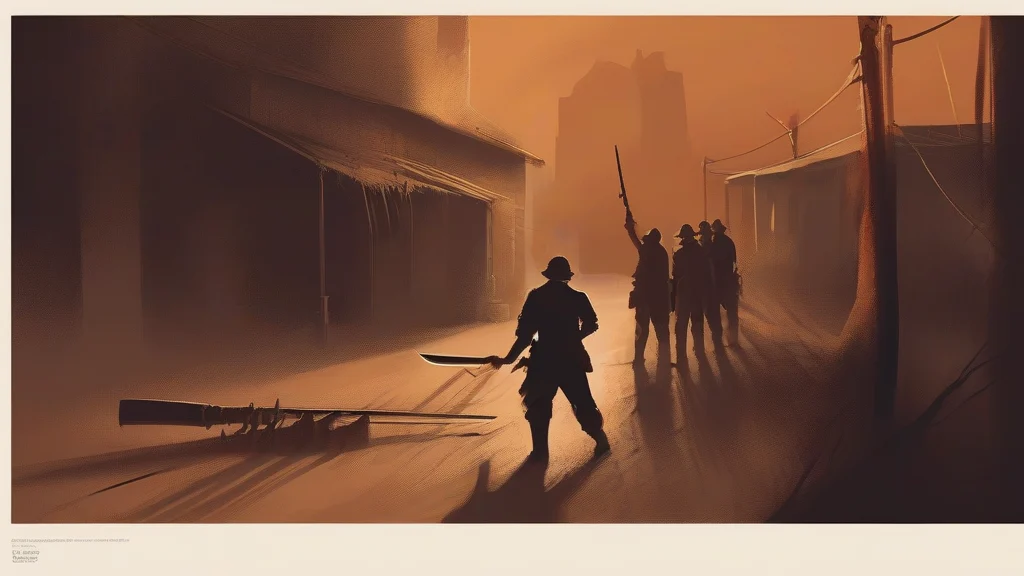
What does bayoneted mean?
"Bayoneted" is the past tense and past participle of the verb "to bayonet," meaning to stab, wound, or kill someone with a bayonet — the long, knife-like blade that mounts on the muzzle of a rifle. The word appears almost entirely in military and historical writing, describing the brutal close-quarters combat that characterized warfare from the seventeenth century through the World Wars. Because bayonet fighting was notoriously savage, the word carries strong connotations of violence and desperation, and it frequently surfaces in battle accounts, memoirs, and war-crimes documentation. It can also be used more loosely to describe driving or piercing something forcefully, though such extended uses are uncommon. The term derives ultimately from the French city of Bayonne, where the weapon itself is said to have originated. For readers of history, "bayoneted" is an essential word for understanding how writers describe the grim reality of pre-modern infantry combat.
verb (past tense and past participle)Past tense and past participle of "bayonet": to have stabbed, killed, or wounded someone with a bayonet.
- To stab or kill (someone) with a bayonet.
- (Extended use) To force or drive something as if impaling it with a bayonet.
"The soldiers charged across the field and bayoneted the enemy sentries before they could sound the alarm."
"Historians estimate that hundreds of soldiers were bayoneted during the desperate hand-to-hand fighting at dawn."
"In the chaos of the trench raid, he bayoneted an enemy rifleman before the man could raise his weapon."
The word comes from Bayonne, France — where this dagger was reportedly first fixed to a musket in the 17th century, forever changing infantry combat.
Reviewed by Deb Chak, Editor. AI-assisted content curated by RJS Tech Solutions LLP.
Etymology of bayoneted
The verb derives from the noun "bayonet," which English borrowed from French "baïonnette" in the mid-seventeenth century. The weapon's name is traditionally traced to the French city of Bayonne, where the plug bayonet was reputedly first made or first fitted to a firearm, though the exact details of that origin are uncertain. As the weapon became standard issue for European infantry, the noun naturally gave rise to a verb, and "bayoneted" has described its deadly use ever since.
Related word forms
How bayoneted is actually used
Almost exclusively used in military and historical contexts, often in accounts of battles, war crimes testimony, or historical fiction. The verb carries inherently violent connotations and is rarely used figuratively outside of expressions like "bayoneted through the canvas" describing forceful piercing.
Easily confused with bayoneted
"Barnacled" means covered with barnacles (small marine crustaceans), while "bayoneted" means stabbed with a bayonet; the two share only a superficially similar rhythm.