What does beaker mean?
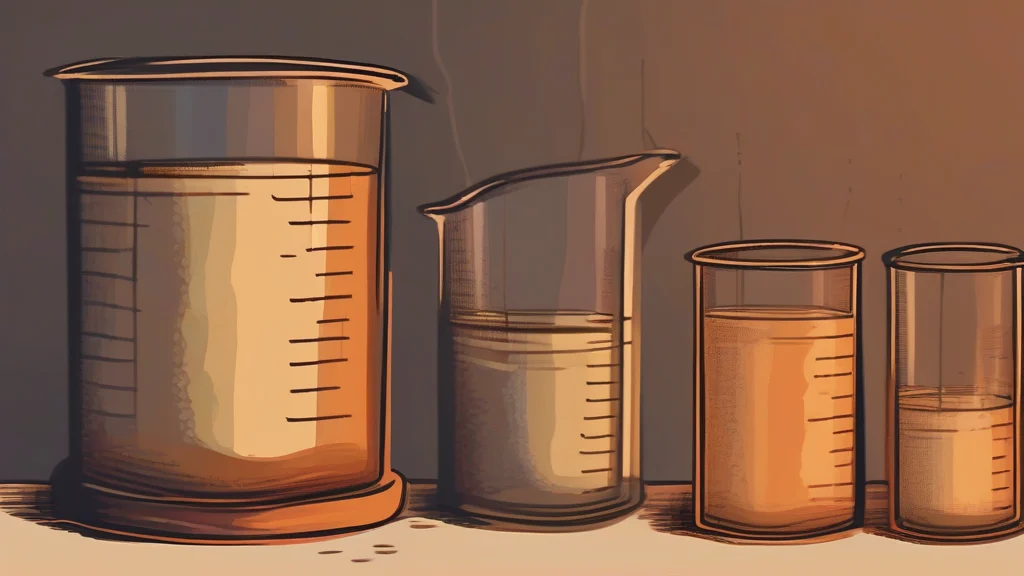
A beaker is a wide, cylindrical vessel with a flat bottom and a small lip for pouring, distinguished by its lack of a handle. The word covers two main uses: in everyday life — particularly in British English — a beaker is a simple drinking cup, often made of plastic or ceramic, commonly used for children's drinks; and in scientific settings, a beaker is one of the most familiar pieces of laboratory equipment, a graduated glass or plastic container used to hold, mix, and heat liquids during experiments. Laboratory beakers come in standard sizes marked with approximate volume graduations, though they are not precision measuring instruments. The word entered English in the medieval period through Scandinavian and Germanic sources, ultimately tracing back to the ancient Greek 'bikos', meaning a wine jar. Its enduring association with both the kitchen and the laboratory makes it a versatile term bridging domestic and scientific vocabulary.
A lipped cylindrical drinking vessel without a handle.
"He filled a beaker with cold water and drank it down."
A flat-bottomed cylindrical container, usually of glass, used in laboratories for holding and measuring liquids.
"The technician labelled each beaker before beginning the titration."
Regular plural formation; used when referring to multiple vessels, whether drinking cups or laboratory containers.
"The cupboard was stocked with clean beakers for the morning's experiments."
The humble lab beaker takes its name from an ancient Greek word for a wine jug — a reminder that chemistry's most iconic glassware began life as something you'd drink from at dinner.
Reviewed by Deb Chak, Editor. AI-assisted content curated by RJS Tech Solutions LLP.
Etymology of beaker
The word 'beaker' entered English in the Middle English period, borrowed from Old Norse 'bikarr' and influenced by Middle Low German 'beker'. These Germanic forms themselves derive from the Latin 'bicarium', which was likely adopted from the ancient Greek 'bikos', meaning a wine jar or earthenware vessel. Cognate forms appear across European languages, such as the Italian 'bicchiere' and French 'bique', reflecting the widespread borrowing of this vessel-word along trade routes.
How beaker is actually used
In everyday British usage, 'beaker' often refers to any handled-less drinking cup, including children's plastic cups. In American English, this sense is less common, and the word is strongly associated with laboratory glassware. The plural is regular ('beakers').
Easily confused with beaker
A flask typically has a narrow neck (as in an Erlenmeyer or volumetric flask), while a beaker is a straight-sided cylindrical vessel with a pouring lip.