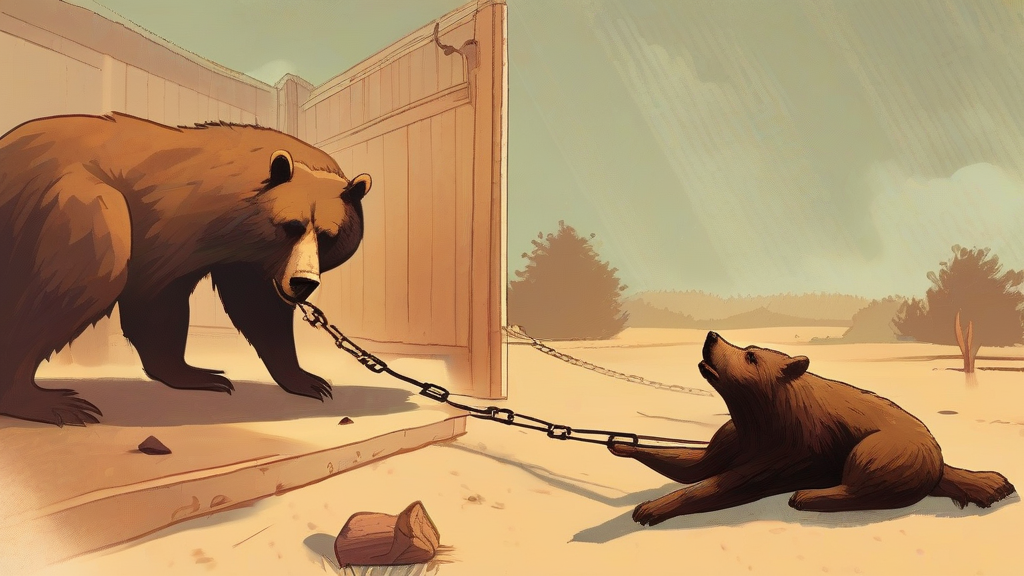
What does bearbaiting mean?
Bearbaiting was a popular entertainment in medieval and early modern Europe, particularly England, in which a bear — often chained by the neck or leg to a stake in an arena called a bear garden — was set upon by trained dogs while spectators wagered on the outcome. Flourishing in Elizabethan London alongside the theatre, it was repeatedly condemned by Puritans and reformers as cruel and barbarous, yet it survived until the nineteenth century; Britain finally outlawed it through the Cruelty to Animals Act of 1835. The word also survives figuratively, describing the relentless hounding or taunting of a defenceless target, a usage that preserves the image of a chained animal unable to flee its attackers. Today bearbaiting endures chiefly as a historical term and as a shorthand for institutionalised cruelty dressed up as sport.
nounA former blood sport in which a bear was chained or tethered and set upon by dogs for public entertainment. By extension, any prolonged harassment or baiting of a person or group.
- The historical blood sport in which a tethered bear was attacked by dogs for public entertainment.
- Figuratively, persistent taunting or harassment of a person, likened to setting dogs on a chained animal.
"In Elizabethan London, bearbaiting drew crowds to the Bear Garden on Bankside."
"Puritan critics condemned bearbaiting as cruel and disorderly, yet it remained popular for centuries."
"The committee meeting had turned into pure bearbaiting, with each member taking turns attacking the proposal."
Rarely pluralized; the uncountable singular is standard even when referring to multiple events.
"Accounts of numerous bearbaitings survive in Tudor records."
Shakespeare's Globe stood within walking distance of a bearbaiting arena — and on some days, the same audience watched both plays and bears fight for their lives.
Reviewed by Deb Chak, Editor. AI-assisted content curated by RJS Tech Solutions LLP.
Etymology of bearbaiting
The compound combines 'bear' with 'baiting', from the verb 'bait', which derives from Old Norse 'beita', meaning to cause to bite or to hunt with dogs. The term arose in Middle English to describe the practice of setting dogs on a bear, and has been in use since at least the late sixteenth century in its established form. It shares this Norse root with related words such as 'bait' and 'bate'.
How bearbaiting is actually used
Almost always used in historical contexts when referring literally; the figurative sense is rare and often carries a connotation of unfairness, since the victim cannot escape. Sometimes hyphenated as 'bear-baiting'.
Easily confused with bearbaiting
The two-word spelling 'bear baiting' is simply a variant of the same term; as a closed compound 'bearbaiting' is the standard dictionary form.