
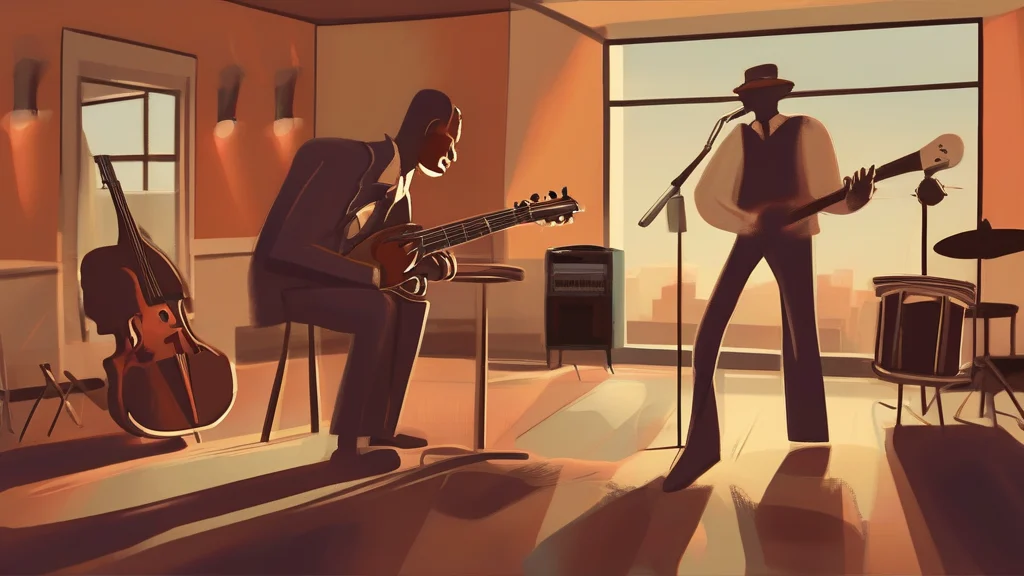
What does bebopper mean?
A bebopper is a musician who plays bebop — the fast-paced, harmonically intricate style of jazz that emerged in New York in the early-to-mid 1940s — or, more broadly, a devoted fan of that music. Bebop moved jazz away from danceable big-band arrangements toward small combos built around virtuosic improvisation, complex chord substitutions, and breakneck tempos; figures such as Charlie Parker and Dizzy Gillespie became archetypal beboppers. The word is formed by adding the agentive suffix -er to bebop, itself coined from the nonsense scat syllables musicians used to vocalize the style's rhythms. Today the term appears chiefly in jazz criticism, biography, and historical writing, often with a warm, nostalgic connotation when applied to the surviving pioneers of the era. It is informal rather than technical, but it is widely understood among anyone with an interest in American music.
nounA bebopper is a musician, especially a jazz instrumentalist, who plays bebop, or an enthusiast or devotee of the bebop style.
- A jazz musician who performs bebop, typically noted for rapid tempos, complex harmony, and improvisation.
- An admirer or follower of bebop music and its associated culture.
"The aging bebopper still ran through Charlie Parker lines every morning before breakfast."
"Dizzy Gillespie was perhaps the most flamboyant bebopper of his generation."
"In the novel, the narrator drifts into a Harlem club and falls under the spell of the beboppers on stage."
Standard regular plural; commonly used collectively to refer to the musicians of the bebop movement as a group.
"The beboppers of the forties scandalized the swing generation with their blistering tempos."
Bebop was so named for its scat syllables — 're-bop-be-bop' — and those who mastered its breakneck tempos earned the name bebopper.
Reviewed by Deb Chak, Editor. AI-assisted content curated by RJS Tech Solutions LLP.
Etymology of bebopper
The word derives from bebop, a term that arose in American jazz circles in the 1940s from the scat syllables — variously rendered as 'be-bop', 'rebop', or 'diz-bop' — used to mimic the new style's jagged rhythmic phrasing. Adding the agentive suffix -er produced bebopper, denoting one who plays or champions the music. Its roots lie in twentieth-century African-American vernacular English rather than in Latin or Greek, so it has no classical cognates, though it is related in spirit to other jazz-era coinages such as hip, hep, and jive.
How bebopper is actually used
Informal to semi-formal register; used mainly in writing about jazz history and culture. It can carry affectionate connotations when applied to veteran musicians of the bebop era, but may sound dated when used of contemporary players.
Easily confused with bebopper
A bebopper is associated with the fast, virtuosic jazz style of the 1940s–50s, whereas a beatnik belongs to the later 1950s literary and countercultural movement.
A swinger plays or dances to swing, the big-band style that preceded bebop, while a bebopper is tied to the smaller-combo, harmonically advanced post-swing idiom.