What does belled mean?
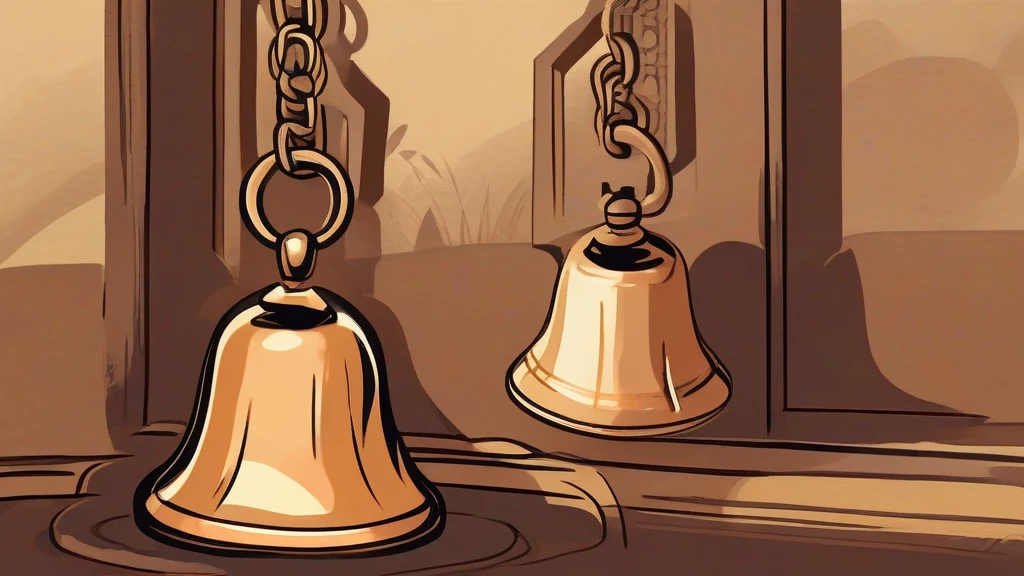
Belled is the past tense and past participle of the verb 'to bell,' meaning to fasten a bell or bells onto someone or something. Shepherds belled their flocks so straying animals could be found by sound; owners belled cats to warn birds; and bells were hung on livestock, doors, and ships' watches. A second, more specialized sense describes animals — especially stags and other deer — crying out loudly during the rutting season, a usage preserved largely in British field sports and nature writing. The word carries rustic, old-world associations: it evokes hillside flocks, cathedral carillons, and the small brass bells that once announced a caller at a door. Though rarely used in everyday modern conversation outside these literal senses, belled remains vivid in historical fiction, poetry, and descriptions of rural life, and it underlies the famous idiom 'who will bell the cat?' — a phrase about undertaking a perilous task for everyone's benefit.
verbThe past tense and past participle of the verb 'bell': to attach a bell or bells to something, or (of an animal) to ring or bellow like a bell, especially in hunting contexts.
- Past tense of bell: to fit or attach a bell or bells to a person, animal, or object.
- (Of animals such as deer or stags) to bellow or cry out during the rutting season; also, in hunting, of hounds giving tongue loudly.
"The shepherd belled his leading ewe so he could track the flock in the fog."
"The goat was belled so the children could follow its tinkling through the hills."
"As dusk fell over the glen, the red stag belled across the valley."
In medieval England, 'belled' sheep wore tiny bells so shepherds could find them at night — and 'to bell the cat' became proverbial for taking on a dangerous task nobody wants.
Reviewed by Deb Chak, Editor. AI-assisted content curated by RJS Tech Solutions LLP.
Etymology of belled
Belled comes from the noun 'bell,' which descends from Middle English 'belle,' likely from Old English 'belle' or borrowed from Old Norse 'bell,' both ultimately of uncertain Germanic origin. The verb arose naturally in Middle English as people fitted bells to animals and objects. The stag's rutting cry called 'belling' is recorded from Middle English onward and is famously used by Shakespeare in Macbeth. Cognates include 'belfry,' which entered English through Old French but whose second element traces to Germanic roots related to 'bell.'
Related word forms
How belled is actually used
Mostly literary or technical today. The animal-cry sense appears chiefly in British hunting literature and nature writing about deer.
Easily confused with belled
'Belled' means fitted with or sounding like a bell, while 'balled' means formed into a ball — they differ only by one vowel sound in speech.