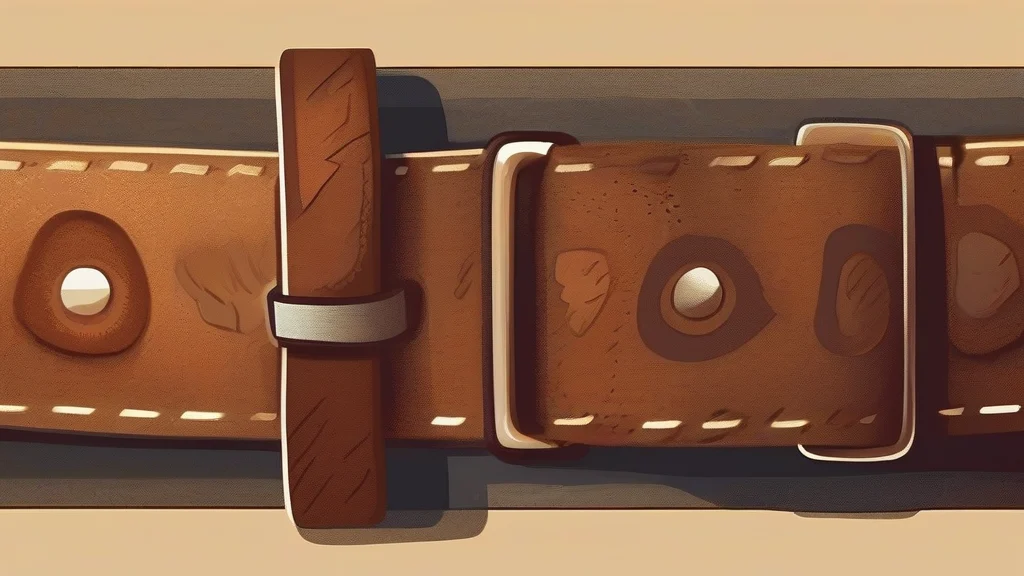
What does belt mean?
A belt is a flexible band — typically of leather or fabric — worn around the waist either to hold up trousers and skirts or simply as a fashion accessory. The word extends naturally to machinery, where a belt is a continuous loop that transfers power between rotating parts, as in a car's timing or fan belt, and to conveyor belts that transport materials in industry. It also describes broad geographical zones marked by a shared feature, from London's green belt to America's Bible Belt. In figurative use, 'tightening one's belt' means spending less during lean times, while a blow 'below the belt' is unfairly delivered. As a verb, belt can mean to strike with a strap or, informally, to sing or travel at full force, as in 'belt out a song'. Derived forms include 'belted', 'belting', and the compound adjective 'belt-tightening'.
A band worn around the waist, especially one made of leather, to hold up or secure clothing.
"He threaded the belt through the loops of his jeans."
A continuous strip or loop of flexible material used to transmit power in machinery or convey goods.
"A broken fan belt left them stranded by the roadside."
A region distinguished by a particular feature or characteristic.
"The farm lies just outside the city's green belt."
To hit with a belt; informally, to strike hard, sing loudly, or move very quickly.
"She belted out the chorus to the delight of the crowd."
Standard regular plural; used both for multiple physical belts and for distinct regional or mechanical zones.
"The department store stocks belts in every shade of brown."
"To tighten your belt" originally meant literally pulling it in a notch during hard times — and the phrase has outlived every economic downturn since.
Reviewed by Deb Chak, Editor. AI-assisted content curated by RJS Tech Solutions LLP.
Etymology of belt
The word 'belt' comes from Old English 'belt' and related Germanic forms, ultimately of Latin origin via Vulgar Latin 'balteus' or 'balteum', meaning a sword-belt or girdle. It was likely borrowed into early Germanic dialects through contact with Roman military culture, which makes it one of the older Latin loanwords in English. Cognates appear across the Germanic languages, including Old Norse 'belti'. The sense of a mechanical drive band developed during the Industrial Revolution, and the verb form followed soon after.
Related word forms
How belt is actually used
'Belt' is common in both formal and informal registers. As a verb ('he belted out a song'), it is distinctly informal. Figurative uses such as 'belt-tightening' are standard in economic and journalistic contexts.
Easily confused with belt
'Built' is the past tense and participle of 'build', meaning constructed, whereas 'belt' is a band worn around the waist or a loop in machinery.