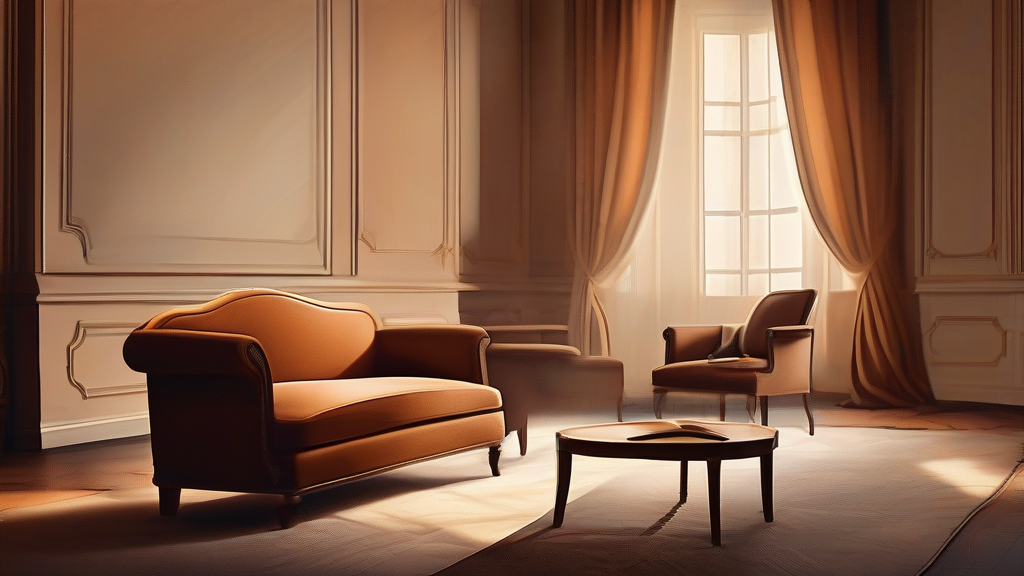
What does bergere mean?
A bergère is a type of upholstered armchair that emerged in France during the early eighteenth century and remains a fixture of classical interior design. Its defining feature is enclosure: unlike open-armed chairs such as the fauteuil, the bergère has curved wooden frames along its arms and sides that are completely covered with upholstery, so the sitter rests within a soft, padded shell rather than on exposed wood. The name comes from the French word for a shepherdess, reflecting the era's taste for pastoral romance even in aristocratic furniture. Today the term appears mainly in antiques dealing, auction catalogues, and interior-design writing, usually describing Louis XV or later pieces, often with gilded frames and fine fabrics. A secondary, literary sense refers simply to a female shepherd, drawn from the same French source.
An upholstered armchair of French origin, dating from the early 18th century, with closed, fabric-covered panels enclosing the arms and sides so the sitter is cushioned all around.
"The dealer attributed the giltwood bergère to a Parisian workshop around 1750."
A female shepherd; a woman who tends sheep.
"In the painting, a young bergère rests beneath a tree while her flock grazes nearby."
This literary sense reflects the direct French borrowing and is now rare in English outside discussions of pastoral art and literature.
The plural follows standard English conventions by adding -s; the acute accent is frequently retained as a French loanword but plain 'bergeres' is also accepted.
"The dining room held two matching bergères in carved walnut."
A chair named after a shepherd girl — 18th-century Parisian furniture makers gave their most cosily enclosed armchair a pastoral name.
Reviewed by Deb Chak, Editor. AI-assisted content curated by RJS Tech Solutions LLP.
Etymology of bergere
The word comes directly from French 'bergère', meaning 'shepherdess', the feminine form of 'berger' ('shepherd'), which traces back through Old French to Late Latin 'berbicarius', derived from Latin 'berbex', meaning a wether or castrated ram. The furniture sense arose in early eighteenth-century France, when the enclosed armchair was given this pastoral name in keeping with the period's fashionable shepherdess motifs. English borrowed the term for both senses, though only the chair sense remains common today.
How bergere is actually used
In interior design contexts the word is almost always applied to furniture and is often italicised or written with the acute accent ('bergère') as a loanword from French; it typically appears in formal, design-oriented writing about antiques and period interiors. The 'female shepherd' sense is literary and largely confined to discussions of French art, poetry, or pastoral tradition.
Easily confused with bergere
A 'bergerie' is the French term for a sheepfold or shepherd's cottage, whereas a 'bergère' denotes either a female shepherd or the enclosed armchair.