What does berm mean?
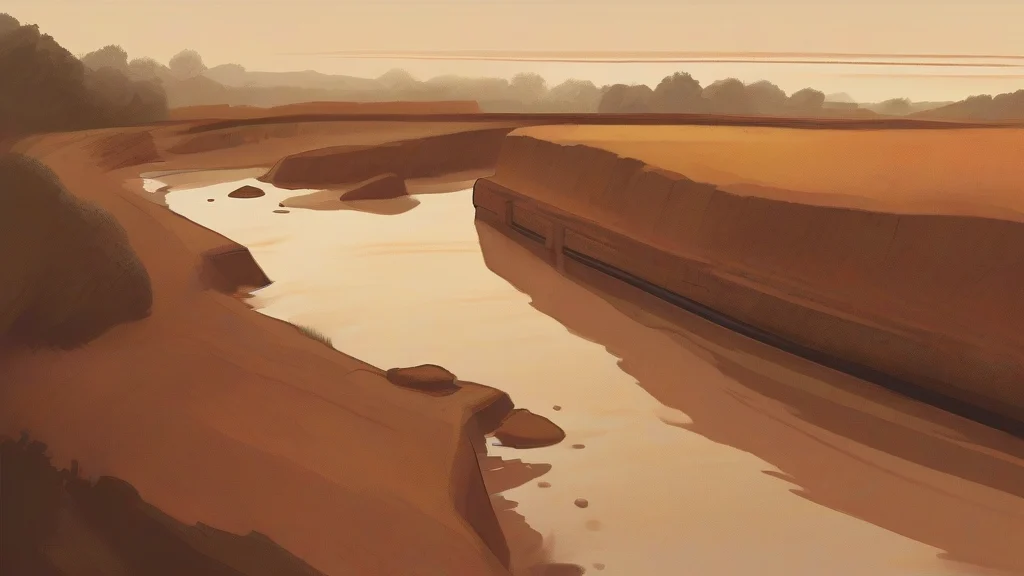
A berm is a narrow ledge, shelf, or strip of ground that sits alongside something larger, most often a road, canal, ditch, or embankment. In everyday and engineering usage it frequently describes the grassy or gravelly margin between a roadway and the surrounding land, though in some regions that space is called a verge or shoulder instead. The word also applies to deliberate mounds of earth built for practical or aesthetic purposes — landscapers shape berms to block noise or create visual interest, while engineers construct them for flood control and military forces have long used them in fortifications. Derived through Dutch from continental European sources, 'berm' entered English several centuries ago but remains most at home in technical and regional speech. It carries no strong connotation of its own, taking its character entirely from context: mundane when describing a roadside strip, purposeful when describing engineered earthworks.
nounA narrow ledge, shelf, or strip of land, especially one at the edge of a road, canal, or embankment, or a raised bank of earth along the side of something.
- A narrow flat ledge or strip of ground at the edge of a road, canal, ditch, or excavation.
- A raised bank of earth, especially one built as part of fortifications, landscaping, or flood control.
"Cyclists paused on the grassy berm beside the highway to watch the sunset."
"The truck pulled onto the gravel berm to let traffic pass."
"Landscape architects shaped a low earthen berm to shield the garden from road noise."
Regular plural formation. Used both for multiple roadside strips and for multiple engineered mounds of earth.
"The park's rolling berms were planted with wildflowers."
That grassy strip you drive past on the edge of every highway has its own name — and it came into English via Dutch, centuries before cars existed.
Reviewed by Deb Chak, Editor. AI-assisted content curated by RJS Tech Solutions LLP.
Etymology of berm
The word 'berm' entered English in the early modern period, borrowed from Dutch 'berm' (also found in early French as 'berme'), where it denoted the narrow strip of ground at the base or edge of a rampart or moat. It was first used in English chiefly in military engineering, describing ledges in fortifications, before extending to roads, canals, and landscaping. Its deeper Germanic roots are shared with words meaning edge or brim, though the precise cognate set is debated by lexicographers.
How berm is actually used
Common in civil engineering, road construction, military fortification, and landscaping contexts. In North America it often refers specifically to the unpaved edge of a road; in some regions this same area is called the 'verge' (British) or 'shoulder'.