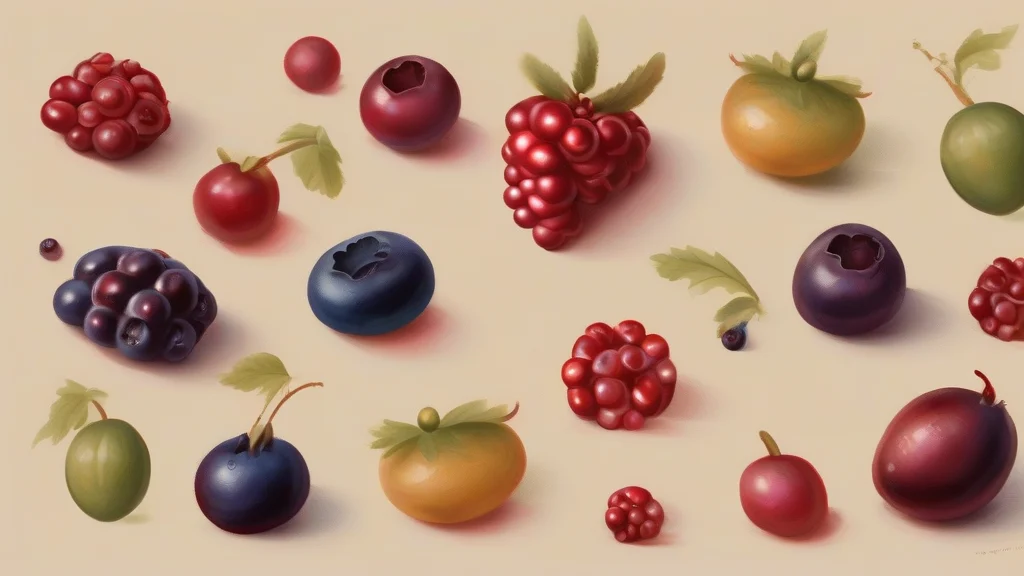
What does berry mean?
A berry is a small, juicy fruit, typically round or oval, valued above all as food. In everyday language the term embraces familiar favourites such as strawberries, raspberries, blueberries, and currants — even though botanists would classify only some of these as true berries. Strictly defined, a berry is a fleshy fruit formed from a single ovary whose seeds are embedded in the pulp, which makes grapes, tomatoes, and even bananas genuine examples while strawberries are not. The word evokes summer hedgerows, jam-making, and foraging, giving it a warm and wholesome register suited to both cooking and literature. It appears in fixed phrases like "berry patch" and "berry picking," and it rhymes readily, making it a favourite of poets and children's verse. Simple, ancient, and universally understood, "berry" is one of those humble words that quietly anchors everyday speech about food and nature.
A small, pulpy, typically edible fruit with seeds, especially one growing on a bush or plant without a stone or pit.
"The hedge was heavy with dark elderberries in late August."
Culinary usage is broader than botanical usage; strawberries and raspberries count as berries in the kitchen though not to a botanist.
(Of a plant) to produce berries.
"The holly finally began to berry after several barren winters."
Rare and chiefly found in gardening or botanical writing.
Standard regular plural; the y becomes -ies after a consonant.
"The recipe calls for two cups of mixed frozen berries."
Botanically speaking, bananas and grapes are true berries, while the strawberry — despite its name — is not one at all.
Reviewed by Deb Chak, Editor. AI-assisted content curated by RJS Tech Solutions LLP.
Etymology of berry
The word "berry" descends from Old English "berie," of Germanic origin, and is closely related to German "Beere." Its ultimate root is the Proto-Germanic word for the fruit itself, making it one of the oldest food words in the English language. It has been in continuous use since before the Norman Conquest, surviving unchanged in essentials across a millennium.
How berry is actually used
In everyday use, "berry" covers many fruits that are not botanical berries (strawberries, raspberries), while excluding some that are (grapes, tomatoes); context determines whether the culinary or scientific sense applies. The word carries warm, wholesome connotations of summer, foraging, and fresh food. The rare verbal sense "to produce berries" exists but is largely confined to gardening contexts.
Easily confused with berry
"Bury" is a verb meaning to place something underground, while "berry" is a noun for a small fruit; they sound nearly identical but share no meaning.