What does bezant mean?
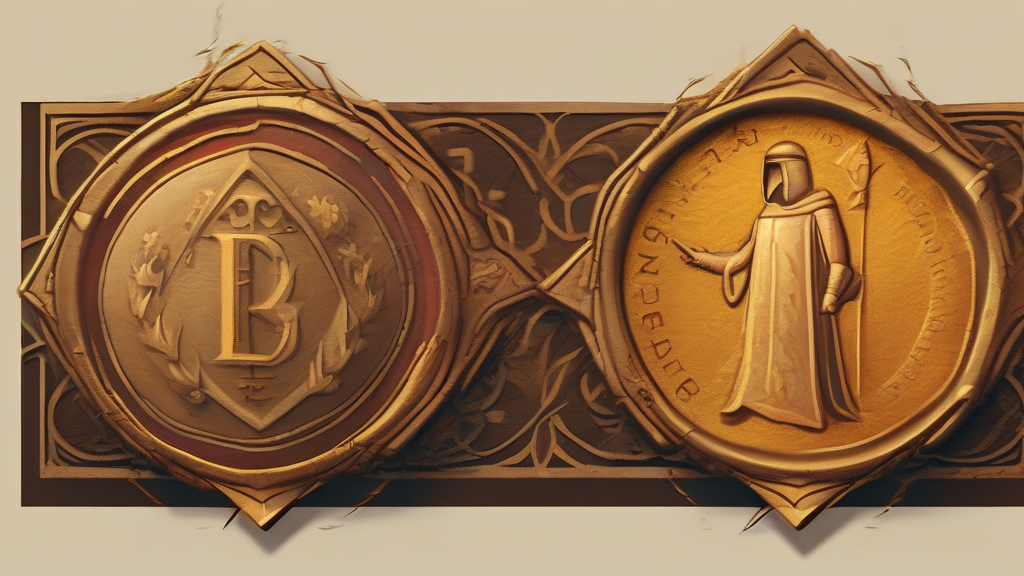
A bezant was the gold coinage of the Byzantine Empire, beginning with the solidus introduced under Constantine the Great and continuing in later forms such as the hyperpyron. Prized throughout the medieval Mediterranean world for its remarkably consistent weight and gold content, it served as an international currency of trade long before the emergence of modern exchange rates. The word entered English through Old French from Latin 'byzantius,' meaning simply 'of Byzantium.' Beyond numismatics, the term survives in heraldry, where a bezant is a plain gold-coloured disc borne on a coat of arms, often arranged in groups such as 'three bezants.' Today the word appears chiefly in historical, economic, and heraldic contexts, giving writing about the Middle Ages a precise and evocative vocabulary. Its plural is regularly 'bezants,' though heraldic usage often leaves the word unchanged after numerals.
A gold coin of the Byzantine Empire, especially the solidus or hyperpyron.
"Crusaders arriving in the East found that bezants were accepted everywhere in place of local silver."
Chiefly historical; common in accounts of Byzantine and medieval Mediterranean trade.
In heraldry, a plain circular charge of gold colour.
"The arms were blazoned as 'Or, three bezants.'"
In strict blazon the word remains unchanged in the plural after a numeral: 'a bend between six bezants.'
The regular plural is 'bezants'; however, in heraldic blazon the word typically stays singular after a numeral, as in 'within a bordure eight bezants.'
"The hoard contained several hundred well-preserved bezants."
The Byzantine gold coin we call the bezant held its value so reliably for roughly seven centuries that medieval traders across Europe and Asia trusted it more than most local currencies.
Reviewed by Deb Chak, Editor. AI-assisted content curated by RJS Tech Solutions LLP.
Etymology of bezant
The word derives from Latin 'byzantius' (nummus), meaning 'coin of Byzantium,' which passed into Old French as 'besant' before entering English in the medieval period. It refers directly to Constantinople, the imperial capital founded on the site of ancient Byzantium, whose gold coinage dominated Mediterranean commerce for centuries. The only true English relatives are the adjectival forms built on 'Byzantine,' sharing the same root referring to the city and empire.
How bezant is actually used
Both senses are somewhat formal or specialist today: the monetary sense appears mainly in historical writing about Byzantium and the medieval Mediterranean economy, while the heraldic sense belongs to the vocabulary of blazon and genealogy. In heraldic description the plural is used attributively without change, e.g. 'a fess between three bezants.'
Easily confused with bezant
A roundel is any circular heraldic charge, while a bezant specifically denotes one coloured gold.
"Besant" is merely an older or alternative spelling of "bezant," not a different word.