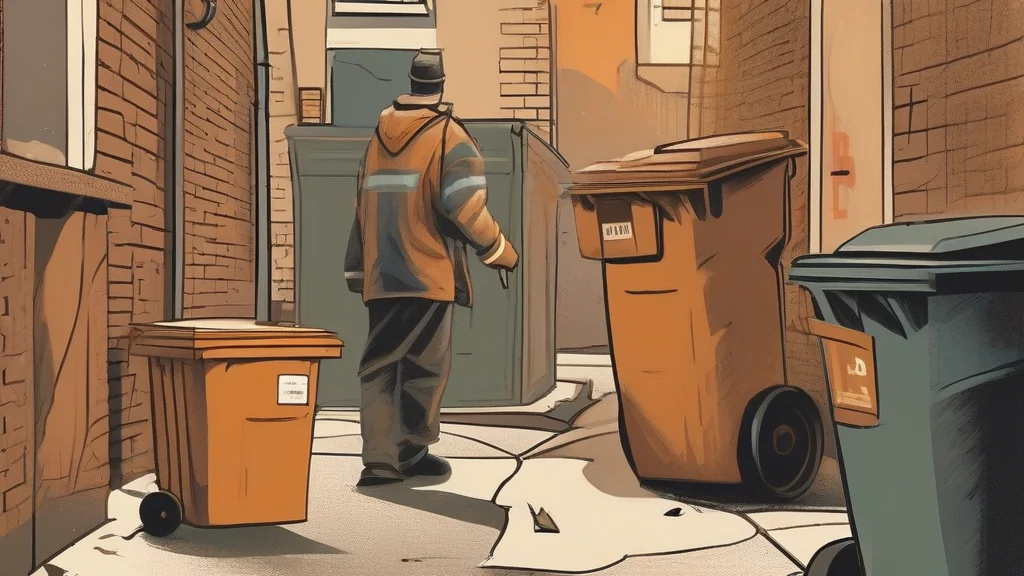
What does binman mean?
A binman is a person employed to collect household waste, emptying domestic bins into a refuse vehicle on a regular collection round. The word is distinctly British and Irish in flavour, serving as the everyday counterpart to the American 'garbage collector' or the more formal British 'refuse collector'. Its plural is irregular — 'binmen' — reflecting its composition from 'bin' plus 'man'. Though informal, the term carries no negative connotation; it is simply what most people call the worker who serves their street each week. Because waste collection is highly visible municipal work, 'binman' often appears in discussions of public services, strikes over pay and conditions, and debates about recycling policy. For learners of British English, it is a useful marker of regional vocabulary, instantly signalling familiarity with UK everyday speech while remaining clear from context even to those encountering it for the first time.
nounA binman is a person whose job is collecting household rubbish from bins, especially on behalf of a local council. The term is the standard British colloquial equivalent of the American 'garbage collector' or 'trash collector'.
- A worker who collects household refuse from bins, typically employed by a local authority.
"The binman empties our street's bins every Tuesday before seven."
"The binman waved cheerfully as he hoisted the wheelie bin onto the lorry."
"During the strike, residents had to take their rubbish to the tip themselves because there was no binman on his usual round."
Irregular plural formed from the 'man/men' pattern within the compound; never write 'binmans'.
"Two binmen lifted the overloaded bins onto the lorry."
In Britain, 'the binman' is such a fixture of daily life that missed collections routinely make local news — proof that some of society's most essential workers are the ones we only notice when they don't show up.
Reviewed by Deb Chak, Editor. AI-assisted content curated by RJS Tech Solutions LLP.
Etymology of binman
Binman is a transparent compound of 'bin', a receptacle for storage or rubbish, and 'man', denoting a person who performs a role. 'Bin' itself derives from Old English 'binn', meaning a crib, basket, or manger, and is cognate with Dutch 'benne'; it came to mean a rubbish container by the nineteenth century. The compound emerged in twentieth-century Britain as the familiar colloquial term for the dustman, gradually displacing that older word in everyday usage.
Related word forms
How binman is actually used
Informal but entirely neutral in tone; 'refuse collector' or 'waste operative' are the more formal terms used by councils. The plural is irregular: 'binmen'. Outside Britain and Ireland, listeners may find the word unfamiliar, so 'rubbish collector' or 'waste collector' travels better internationally.
Easily confused with binman
'Dustman' is an older British synonym for the same job, now largely replaced by 'binman', so the two denote the same occupation rather than different ones.