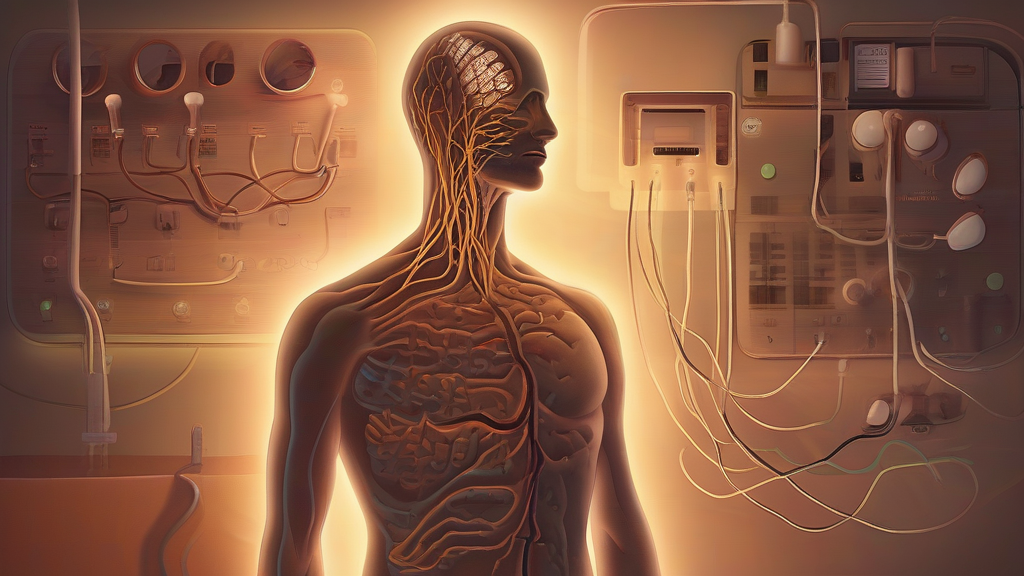
What does bioelectrical mean?
Bioelectrical is an adjective describing anything related to the electrical activity or properties of living organisms. All living tissues generate tiny electrical potentials — nerve impulses, heartbeats, muscle contractions, and brain waves are all fundamentally bioelectrical events. The word appears most often in scientific and medical contexts: researchers speak of bioelectrical signals, bioelectrical activity, and bioelectrical recordings when studying how the body's cells communicate and coordinate. It also features prominently in health technology, most notably in bioelectrical impedance analysis (BIA), a widely used method for estimating body composition by passing a harmless low-level current through the body and measuring its resistance. Because the term is technical, it rarely surfaces in casual conversation, but it conveys precision and authority wherever electricity meets biology. Its roots lie in the Greek 'bios' (life) and the study of electricity, reflecting a field that bridges physics and life science. Understanding 'bioelectrical' helps readers make sense of fitness devices, medical diagnostics, and neuroscience reporting alike.
Of or relating to the electrical phenomena, impulses, or properties produced by living organisms or their tissues.
"Electrodes on the scalp detect the brain's faint bioelectrical rhythms."
Almost always found in technical or scientific registers.
Involving the measurement of electrical characteristics of the body for diagnostic or analytical purposes.
"The smart scale uses bioelectrical impedance to estimate body fat percentage."
Common in consumer health and fitness contexts, especially the fixed phrase 'bioelectrical impedance analysis'.
Every thought you have right now is a storm of bioelectrical signals — your brain runs on about 20 watts, roughly the power of a dim light bulb.
Reviewed by Deb Chak, Editor. AI-assisted content curated by RJS Tech Solutions LLP.
Etymology of bioelectrical
The word combines two roots: 'bio-', from the ancient Greek 'bios' meaning 'life', and 'electrical', from 'elektron', the Greek word for amber, whose ability to attract lightweight objects when rubbed gave rise to the modern concept of electricity. The compound emerged in the nineteenth and twentieth centuries as scientists discovered that living tissues produce measurable electrical currents. Cognate forms include 'bioelectricity', the noun naming the phenomenon itself, and related coinages such as 'electrophysiology'.
Related word forms
How bioelectrical is actually used
A formal, scientific term used mainly in physiology, medicine, and fitness technology rather than everyday speech. In compounds like 'bioelectrical impedance analysis' it is standard in medical and sports-science literature.
Easily confused with bioelectrical
'Bioelectric' and 'bioelectrical' are near-interchangeable adjectives; the '-al' form is somewhat more common in technical writing such as 'bioelectrical impedance analysis', while 'bioelectric' often appears in compound nouns like 'bioelectric field'.