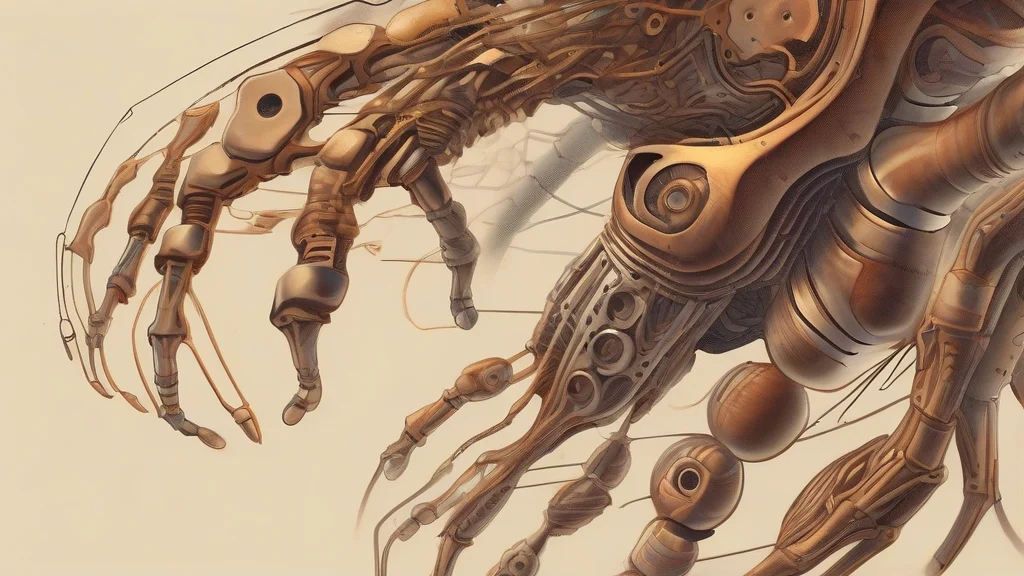
What does biomechanical mean?
"Biomechanical" is an adjective describing anything that unites the principles of mechanics with living systems. In its dominant scientific sense, it refers to the analysis of how biological structures — muscles, tendons, bones, joints — generate and withstand forces during movement. Sports scientists use biomechanical assessments to refine athletic technique, while orthopedic surgeons rely on biomechanical modeling to design implants that mimic natural joint behavior. The word carries a precise, technical tone in medicine and engineering, but it has also taken on a vivid second life in popular culture, where "biomechanical" describes a distinctive aesthetic blending organic forms with machine parts, seen everywhere from H.R. Giger's artwork to prosthetic limb design and video game creatures. This dual character makes the word unusually versatile: equally at home in a peer-reviewed journal on gait analysis and in a film review praising a biomechanical monster design. Its roots lie in the Greek-derived prefix "bio-" (life) combined with "mechanical," reflecting its core idea — life understood through the lens of machines.
Of or relating to the mechanics of living bodies; applying mechanical principles — force, motion, stress — to biological structures and their movement.
"Biomechanical studies of sprinters show how much energy the ankle stores and releases with each stride."
In scientific writing, this sense is standard and unambiguous; in general prose it often signals a technical or specialist context.
Designating a hybrid form or style combining organic, biological elements with mechanical components, especially in science fiction, art, and prosthetic design.
"The alien's biomechanical exoskeleton appeared grown rather than built, all sinew and gleaming alloy."
This figurative sense is common in pop culture criticism and creative fields but is less likely to appear in formal academic writing.
The word "biomechanical" bridges two worlds — it's how engineers decode the elegance of a cheetah's sprint, and how sci-fi artists imagine flesh fused with machine.
Reviewed by Deb Chak, Editor. AI-assisted content curated by RJS Tech Solutions LLP.
Etymology of biomechanical
"Biomechanical" is formed from the Greek-derived combining form "bio-", meaning "life", attached to "mechanical", which traces back through Latin "mechanicus" to Greek "mēkhanikos", relating to machines or contrivance. The compound reflects the rise of biomechanics as a formal discipline in the late nineteenth and twentieth centuries, as physiologists began applying Newtonian mechanics to animal and human movement. Cognates sharing these roots include "biology" (from Greek "bios") and "mechanics" itself.
Related word forms
How biomechanical is actually used
"Biomechanical" is primarily a technical term used in scientific, medical, and engineering contexts, giving it a formal register; however, its extended sense describing an organic-mechanical aesthetic appears frequently in science fiction, gaming, and popular culture.
Easily confused with biomechanical
"Mechanical" refers generally to machines or physical forces, whereas "biomechanical" specifically combines biology with mechanics, applying mechanical principles to living organisms.