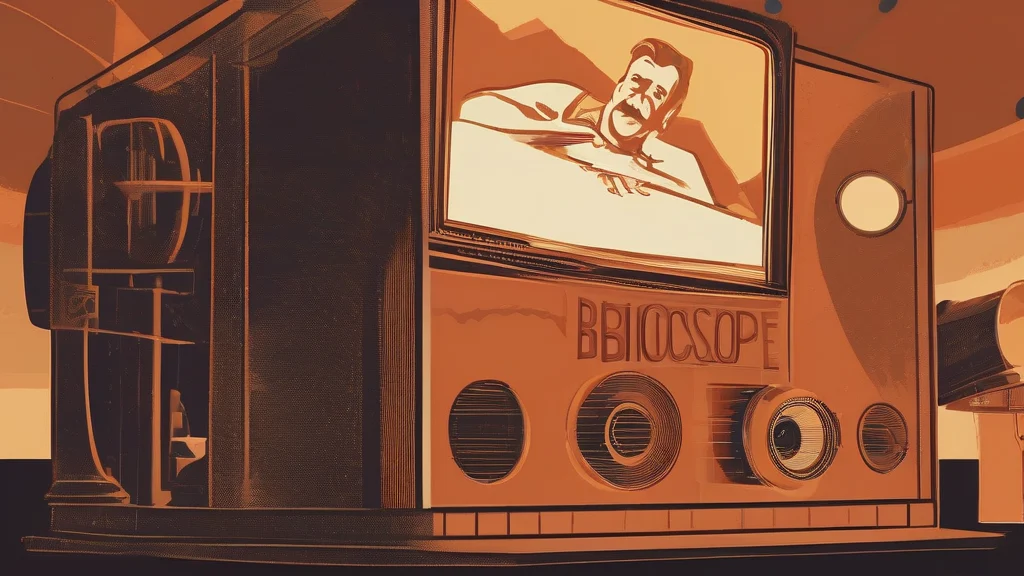
What does bioscope mean?
A bioscope is an early motion-picture projector, one of the devices that brought moving images to paying audiences at the very birth of cinema in the late nineteenth century. Formed from the Greek roots bios ('life') and skopein ('to look at'), the term literally suggests a machine for viewing life. As commercial film exhibition spread across the British Empire, 'bioscope' took on a second meaning: in South Africa and parts of South Asia it became the ordinary word for a cinema itself, so that people spoke of going to the bioscope much as Americans said they were going to the movies. Today the word sounds charmingly antiquarian to most English speakers, evoking flickering silent films, travelling showmen, and ornate picture palaces, yet it remains living vocabulary in South African English. For readers interested in film history or regional variation in English, 'bioscope' offers a vivid reminder of how quickly new technologies coin new words — and of how some of those words outlive the machines that inspired them.
nounAn early motion-picture projector, originally a brand name for such a device. In South Africa and parts of South Asia the word came to mean a cinema or movie theatre.
- An early device for projecting moving images onto a screen; an early film projector or cinematograph.
- (Chiefly South African and Indian English) A cinema or movie theatre.
"The old bioscope on Main Street still shows its original Art Deco facade."
"Pioneering showmen toured the countryside with a bioscope, amazing audiences with their first glimpse of moving pictures."
"The family spent every Saturday evening at the local bioscope in Durban."
Standard regular plural; used both for multiple projectors and for multiple cinemas.
"Travelling exhibitors carried their bioscopes from town to town."
In South Africa and India, generations of moviegoers didn't go to 'the pictures' or 'the movies' — they went to the bioscope.
Reviewed by Deb Chak, Editor. AI-assisted content curated by RJS Tech Solutions LLP.
Etymology of bioscope
The word 'bioscope' combines the Greek elements bios, meaning 'life', and skopos/skopein, relating to looking or observing, following the pattern of other scientific coinages such as microscope and telescope. It emerged in the late nineteenth century as a name for optical instruments and was adopted as a brand name by early motion-picture equipment makers, notably in Britain, around the dawn of cinema. Through imperial trade routes the word travelled to South Africa and South Asia, where it settled into everyday speech as the local term for a cinema, a usage that endures most strongly in South African English today.
How bioscope is actually used
The word is largely historical in Britain and North America, where it was used in the earliest years of cinema before being displaced by terms like 'cinematograph' and 'the movies'. It survives as everyday vocabulary in South Africa, where 'bioscope' remains a common word for a cinema, and it is also familiar in older Indian English usage.
Easily confused with bioscope
A biopsy is the removal of tissue for medical examination, whereas a bioscope is an early film projector or, regionally, a cinema.