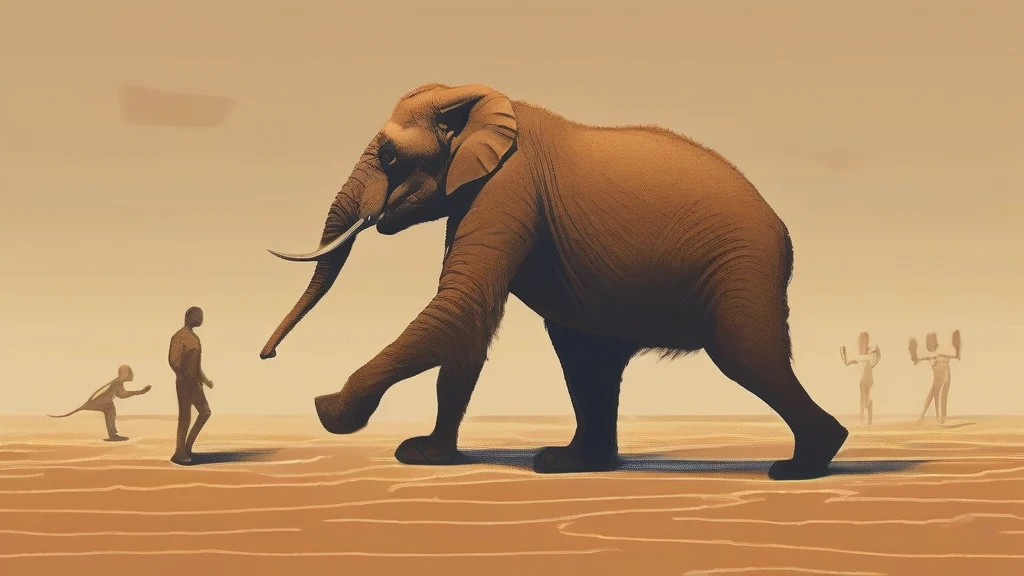
What does bipedalism mean?
Bipedalism is the condition or practice of moving about on two legs, and it is chiefly used as a technical term in biology, anthropology, and paleontology. It describes not only the physical capacity for upright, two-legged locomotion but also, in discussions of human origins, the evolutionary adaptation that set early hominins apart from their ape relatives. Scientists distinguish between habitual or obligate bipedalism, where an animal moves on two legs by default, and facultative bipedalism, where two-legged movement is only occasional. Among living animals, humans and birds are the most prominent bipeds, though many other creatures can move briefly on two limbs. Because standing upright freed the hands for carrying objects and manipulating tools, bipedalism is widely regarded as one of the pivotal developments in human evolution. The word derives from Latin roots meaning 'two' and 'foot', and its everyday adjective form is 'bipedal'.
nounThe practice, condition, or mode of locomotion of walking upright on two legs. In biology and anthropology, it refers specifically to habitual two-legged movement as a defining trait of humans and some other animals.
- The ability, habit, or mode of walking upright on two hind limbs (used of animals such as humans and birds).
- In anthropology, habitual two-legged locomotion as a key evolutionary adaptation distinguishing hominins from other apes.
"Bipedalism is considered one of the earliest defining characteristics of the human lineage."
"Birds are the only living dinosaurs whose bipedalism persisted across millions of years."
"Fossil evidence suggests that early hominins adopted bipedalism long before they developed large brains."
Walking on two legs freed human hands for tool-making — making bipedalism arguably the first step toward everything that followed.
Reviewed by Deb Chak, Editor. AI-assisted content curated by RJS Tech Solutions LLP.
Etymology of bipedalism
Bipedalism derives from the Latin 'bipes' meaning 'two-footed', formed from 'bi-' (two) and 'pes' (foot), combined with the suffix '-ism' denoting a state or practice. The adjective 'bipedal' entered English earlier, and the noun 'bipedalism' arose in the nineteenth century alongside the growth of comparative anatomy and evolutionary science. It shares its Latin root with words such as 'pedal', 'pedestrian', and 'centipede', all ultimately tracing back to the Proto-Indo-European root *ped- meaning foot.
Related word forms
How bipedalism is actually used
Bipedalism is primarily a scientific and academic term, common in anthropology, paleontology, zoology, and biomechanics. It is uncountable in standard usage. The related adjective is 'bipedal', and the noun for a two-legged creature is 'biped'.
Easily confused with bipedalism
Bipedality is a near-synonym meaning the state of being two-legged, while bipedalism more often emphasizes the act or mode of two-legged locomotion; in practice the two are largely interchangeable.