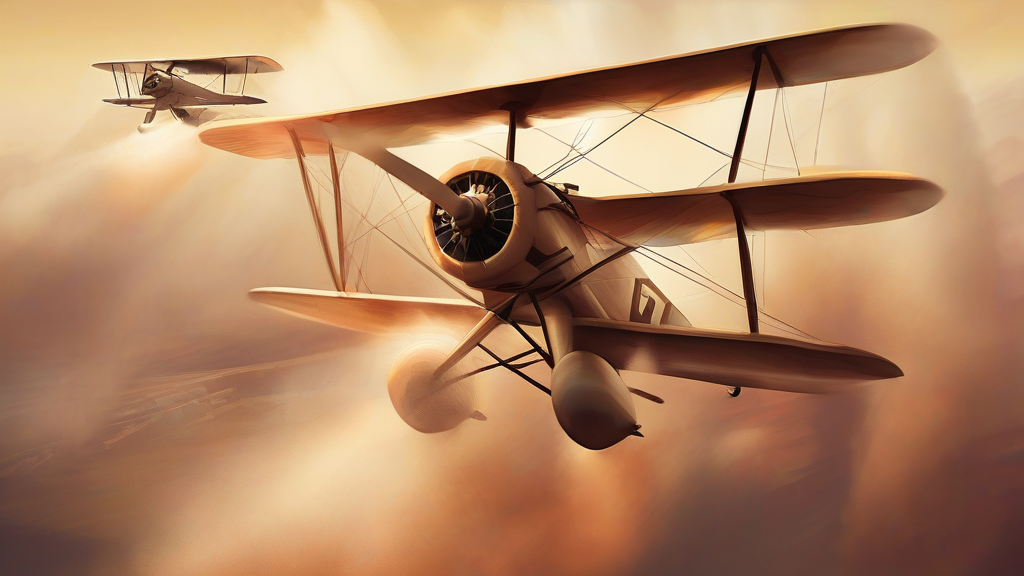
What does biplane mean?
A biplane is an aircraft whose lifting surfaces consist of two pairs of main wings mounted one above the other on either side of the fuselage, typically connected by struts and bracing wires. The design dominated the first decades of powered flight: its stacked wings gave early engines enough lift and structural strength to get aloft, making the biplane the defining shape of pioneer aviation and of the fighter aircraft of World War I. Famous examples include aircraft flown during that conflict and classic trainers such as the de Havilland Tiger Moth. As engine power and all-metal construction advanced, streamlined monoplanes displaced biplanes for most purposes, though a handful of aerobatic and crop-dusting designs kept the layout alive well into the modern era. Today "biplane" carries strong historical and nostalgic connotations, evoking open cockpits, fabric-and-wire construction, and barnstorming airshows. The word is standard in both British and American English and is used in aviation history, museums, and recreational flying contexts.
nounAn early type of aircraft with two pairs of wings, one above the other, fixed to the same fuselage.
- An aircraft with two main wings stacked one above the other on either side of the fuselage.
- (By extension) any of the early-generation aircraft so built, especially those of the pioneer era and World War I.
"The vintage biplane looped gracefully over the airfield, drawing cheers from the crowd below."
"Pilots at the heritage airshow flew restored biplanes from the 1930s in formation over the valley."
"In the museum hangar stood a fabric-covered biplane, its two wing levels braced by struts and wire."
Regular plural; used when referring to multiple aircraft of this type.
"Dozens of biplanes gathered for the centenary flypast."
The Red Baron shot down most of his 80 victories from the cockpit of a red biplane — and biplanes ruled the skies of World War I despite being invented barely a decade after Kitty Hawk.
Reviewed by Deb Chak, Editor. AI-assisted content curated by RJS Tech Solutions LLP.
Etymology of biplane
The word "biplane" was formed in English in the early twentieth century from the Latin-derived prefix "bi-" ("two") combined with "plane," meaning a flat or level surface, as used for an aeroplane's wing. It arose alongside sibling coinages such as "monoplane" (one wing pair) and "triplane" (three), which share the same "-plane" element. The prefix "bi-" itself comes from Latin and appears in many other English words such as "bicycle," "bilingual," and "biannual."
How biplane is actually used
"Biplane" is a neutral technical and historical term. It is strongly associated with early aviation — roughly 1900 to the 1930s — so using it about modern aircraft would be inaccurate unless referring to aerobatic or agricultural aircraft still built with two wings.
Easily confused with biplane
A monoplane has a single pair of wings, whereas a biplane has two pairs stacked one above the other.