What does birdcage mean?
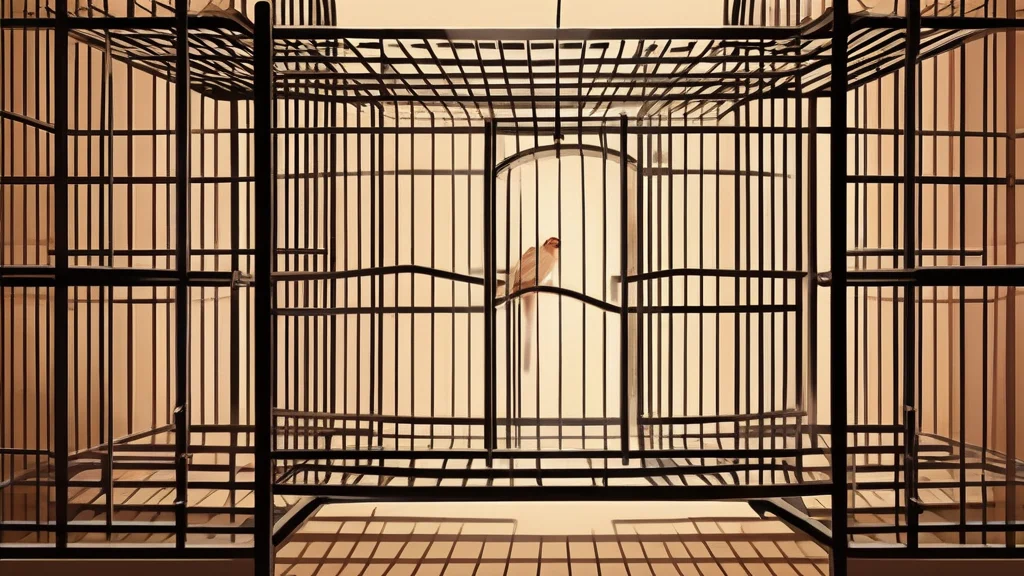
A birdcage is a container, traditionally constructed from wire, metal bars, or occasionally wood, designed to house pet or captive birds such as canaries, budgerigars, or parrots. The word is straightforwardly literal in most contexts, referring to the familiar household object hung in a window or placed on a stand. Beyond its literal sense, 'birdcage' carries rich figurative weight: writers frequently use it as a metaphor for confinement, restriction, or a life that is comfortable yet limiting — hence expressions like 'a gilded birdcage,' which evokes luxurious imprisonment. In fashion, a 'birdcage veil' is a short netting veil that frames the face, named for its resemblance to wire mesh. Decorative empty birdcages are also popular in interior design as planters or ornamental pieces. Simple, concrete, and widely understood, the word is a staple of everyday English with a surprisingly versatile figurative life.
nounA cage for keeping or confining birds, typically made of wire or metal bars. Figuratively, it can describe any confined space or situation that feels restrictive.
- A container, usually of wire or bars, for keeping pet or captive birds.
- A structure resembling a birdcage in shape, such as a protective cage over machinery or a decorative framework.
"The canary sang cheerfully from inside its brass birdcage by the window."
"She hung the wooden birdcage from the beam of the porch, filling it with trailing ivy instead of a bird."
"The mill's gears were shielded by a wire birdcage to prevent accidents."
Regular plural formation; used when referring to multiple cages or to the object generically.
"The shop displayed dozens of birdcages of every size and colour along its back wall."
In Victorian England, an ornate birdcage in the parlour was a status symbol — and some were so elaborate they cost more than the bird itself.
Reviewed by Deb Chak, Editor. AI-assisted content curated by RJS Tech Solutions LLP.
Etymology of birdcage
The word 'birdcage' is a straightforward compound of 'bird,' from Old English 'bridd' meaning a young bird or chick, and 'cage,' which entered Middle English from Old French 'cage,' ultimately derived from Latin 'cavea,' meaning a hollow place, enclosure, or aviary. The compound has been in use since at least the late Middle English period, when keeping songbirds in cages became a common domestic practice. Its Latin root 'cavea' also gives us related words such as 'cage' in its other senses and, more distantly, 'cave.'
How birdcage is actually used
The word is neutral in register and used in both everyday and literary contexts. Figurative uses often carry connotations of confinement, restriction, or gilded captivity — as in the phrase 'a gilded birdcage' suggesting comfortable but limited freedom.
Easily confused with birdcage
An aviary is a large enclosure for birds to fly within, while a birdcage is a smaller, portable container for one or a few pet birds.