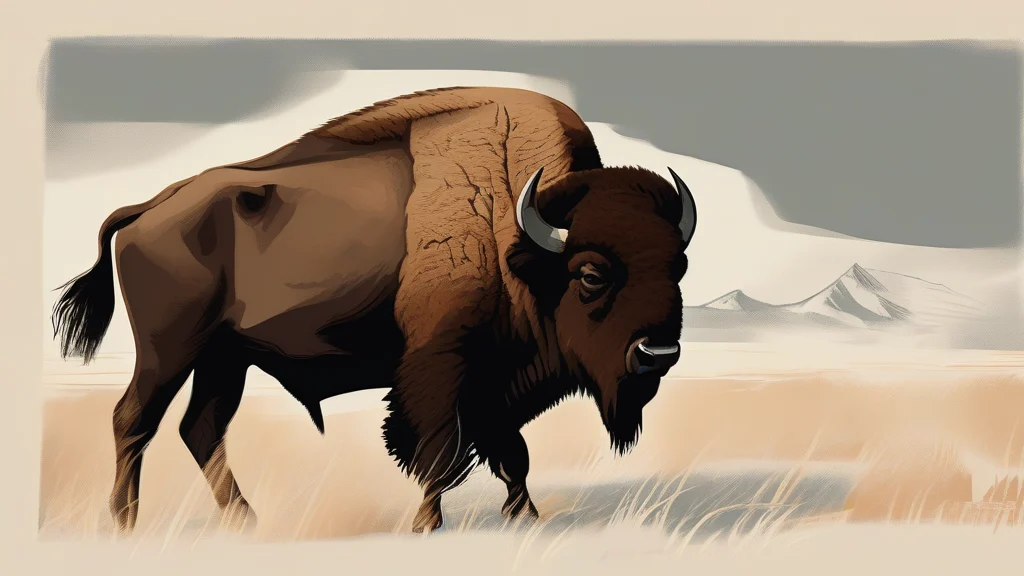
What does bison mean?
A bison is a very large, heavily built wild ox distinguished by a massive head, a pronounced shoulder hump, and a thick, shaggy brown coat. Two species exist: the American bison (Bison bison), which roamed the Great Plains in enormous herds before being driven nearly to extinction in the nineteenth century, and the European bison (Bison bonasus), also called the wisent, which now survives mainly in protected forests and reserves. In everyday American speech the animal is often informally called a buffalo, though this name properly belongs to unrelated African and Asian species; "bison" is the scientifically accurate term. The plural is normally also "bison." The word carries strong connotations of the American frontier and wilderness conservation, making it both a practical vocabulary word and a culturally resonant one.
nounA large wild bovine mammal with a massive head, shoulder hump, and shaggy coat; specifically the American bison of North America or the closely related European bison (wisent).
- The American bison (Bison bison), a large shaggy-maned bovine of North America, often called the buffalo in everyday speech.
- The European bison (Bison bonasus), also known as the wisent, a related species surviving in forest reserves of eastern Europe.
"Herds of bison once thundered across the Great Plains in numbers beyond counting."
"The bison grazed peacefully on the open prairie as the sun set behind the hills."
"Conservationists have worked for a century to reintroduce the European bison to its native woodlands."
The plural is typically unchanged ("several bison"); "bisons" is rare and generally avoided.
"Thousands of bison once migrated across the plains each year."
In the late 1800s, North America's bison population collapsed from tens of millions to fewer than a thousand — one of the narrowest escapes from extinction ever recorded.
Reviewed by Deb Chak, Editor. AI-assisted content curated by RJS Tech Solutions LLP.
Etymology of bison
The word "bison" entered English in the early seventeenth century, borrowed directly from Latin bison, which itself was taken from a Germanic source. It is ultimately related to "wisent," the English name for the European bison, both tracing back to the same ancient root for the wild ox. The Latin term was applied by naturalists to distinguish these humped, shaggy oxen from true buffaloes.
How bison is actually used
In American English, "bison" is the technically precise term, though "buffalo" remains widespread in casual usage. The plural is usually also "bison," though "bisons" is occasionally seen.
Easily confused with bison
"Buffalo" colloquially refers to the American bison, but true buffaloes (Cape buffalo, water buffalo) are different animals native to Africa and Asia.