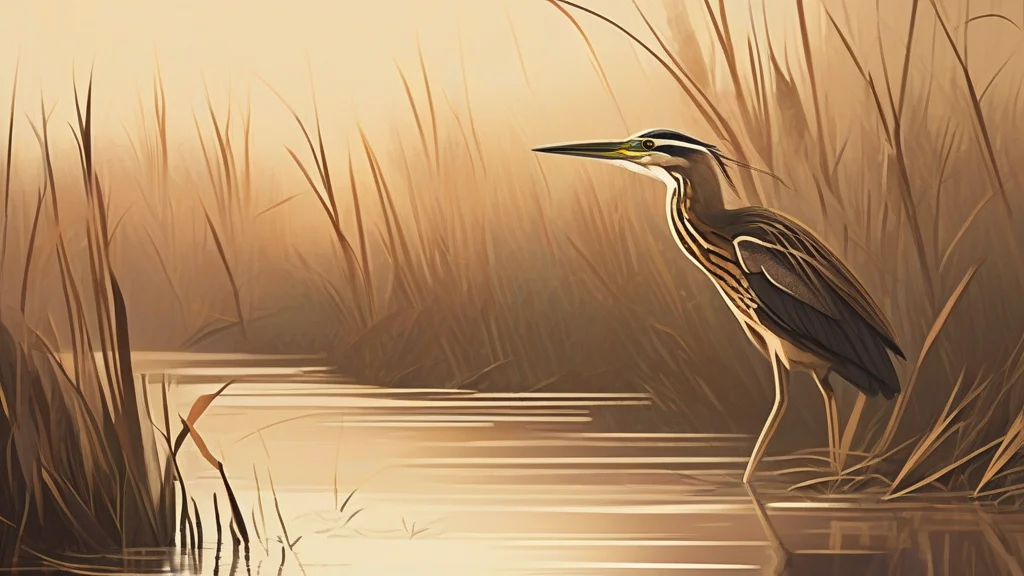
What does bittern mean?
A bittern is a large, heavily streaked brown bird belonging to the heron family, adapted for life concealed among dense reeds and marshes. The best-known species is the Eurasian bittern (Botaurus stellaris), whose males produce one of the most remarkable sounds in the bird world: a deep, resonant boom, created by inflating the throat and amplified by the surrounding air, that carries great distances across wetlands. North America hosts its own species, the American bittern (Botaurus lentiginosus). Bitterns are famously elusive; their vertical posture and striped plumage blend seamlessly into reeds, making them far more often heard than seen. The word appears mainly in ornithological, birdwatching, and nature-writing contexts, and it carries strong connotations of wild, hidden wetland landscapes. Because bittern populations depend on extensive reedbeds, the bird has become an emblematic species in wetland conservation, and its return to restored habitats is often reported as a sign of ecological recovery.
nounA large, secretive marsh bird of the heron family, with streaked brown plumage and a booming call, especially the Eurasian bittern (Botaurus stellaris); also any of several related wading birds.
- The Eurasian bittern (Botaurus stellaris), a large heron-like marsh bird famed for its camouflage and the male's resonant booming call.
- Any of various other related marsh birds, notably the American bittern (Botaurus lentiginosus) and small 'least' or 'yellow' bitterns of the genus Ixobrychus.
"At dusk we heard the deep booming of a bittern echoing across the reedbed."
"Conservationists celebrated when the bittern returned to breed at the restored wetland after decades of absence."
"An American bittern stood motionless among the cattails, its bill pointed skyward to mimic the surrounding vegetation."
Regular plural; used both for multiple birds and generically for the group.
"Several bitterns wintered in the reserve this year."
The male bittern's eerie, foghorn-like boom can carry over two miles through the reeds — yet the bird itself is so camouflaged it's rarely seen.
Reviewed by Deb Chak, Editor. AI-assisted content curated by RJS Tech Solutions LLP.
Etymology of bittern
The word bittern entered Middle English from Old French butor, which itself derives from Medieval Latin forms such as butionem or butitius, ultimately of uncertain origin. The modern form was shaped by folk-etymological association with the adjective "bitter," even though the two words have no genuine etymological connection. The term has been applied since medieval times to the Eurasian bittern, a bird once prized as table fare and later celebrated for its haunting call.
How bittern is actually used
A formal-to-neutral naturalist term used chiefly in birdwatching, ornithology, and nature writing; it has little figurative use. When unqualified in British English it usually means the Eurasian bittern, while in North America it typically refers to the American bittern.
Easily confused with bittern
"Bitter" describes a sharp, pungent taste or feeling, while "bittern" is a marsh-dwelling bird; they differ by one letter but are unrelated in meaning.
A "mitten" is a glove covering the hand without separate fingers, whereas a "bittern" is a wading bird — similar rhythm and spelling can cause momentary confusion.