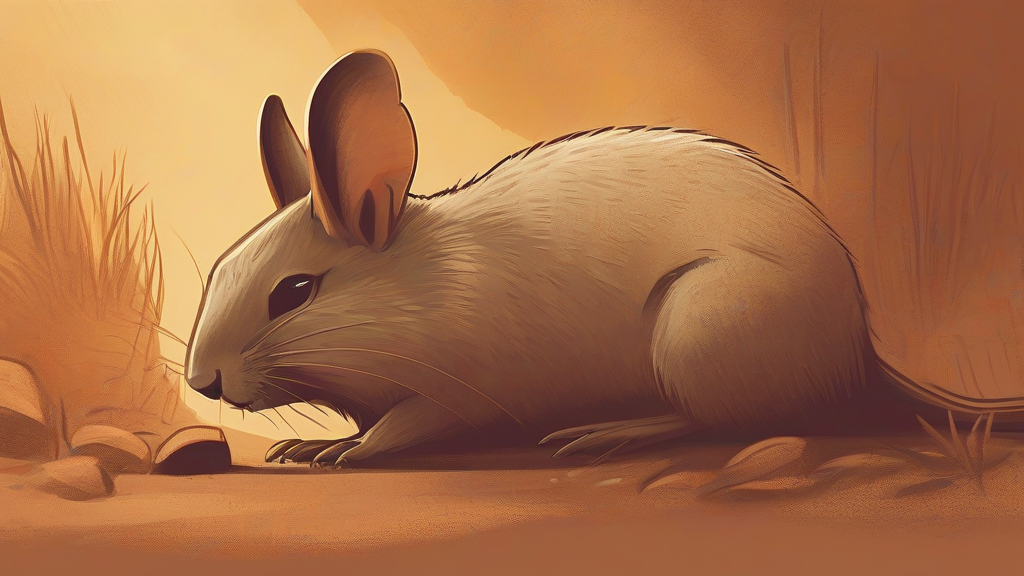
What does bizcacha mean?
A bizcacha is a large, gregarious burrowing rodent native to the grasslands of southern South America, particularly the Argentine pampas, Paraguay, and Bolivia. Scientifically known as Lagostomus maximus and more commonly spelled 'vizcacha' or 'viscacha', it belongs to the chinchilla family and is notable for its size — roughly that of a small hare — its grizzled grey-and-black coat, and its striking facial markings, including black-and-white stripes on the male. Bizcachas live in colonies that dig vast networks of interconnected burrows called vizcacheras, which can persist for generations and provide shelter for many other species, including burrowing owls. Because these excavations alter soil and vegetation across the plains, the animal plays a significant ecological role, though it has historically been regarded by ranchers as a pest. In English, the word appears almost exclusively in natural-history and zoological writing.
nounA bizcacha is a large South American burrowing rodent of the genus Lagostomus, resembling a rabbit-sized chinchilla, native to the plains of Argentina, Paraguay, and Bolivia. It lives colonially in extensive underground burrow systems known as vizcacheras.
- The plains viscacha (Lagostomus maximus), a colonial burrowing rodent of the South American pampas, related to the chinchilla.
"The grasslands were riddled with the burrows of the bizcacha, whose colonies stretched for acres across the pampas."
"Riders on the Argentine pampas had to watch their horses, which often stumbled in the abandoned burrows of the bizcacha."
"Naturalists describe the bizcacha as a highly social rodent, living in groups dominated by a single resident male."
Regular plural; the anglicized form is standard in English rather than any adapted plural.
"Dozens of bizcachas sunned themselves at the mouths of their burrows each morning."
The bizcacha's burrow complexes can house dozens of animals and are so durable that burrowing owls and other creatures move in uninvited — making it one of South America's most generous landlords.
Reviewed by Deb Chak, Editor. AI-assisted content curated by RJS Tech Solutions LLP.
Etymology of bizcacha
The word entered English in the early nineteenth century through Spanish 'vizcacha', itself borrowed from a Quechuan source (wisk'acha), the indigenous language of the Andes where the animal and its relatives occur. It thus shares its origin-language with other Quechua loanwords adopted into European languages, such as 'vicuña', 'condor', and 'puma'. Variant spellings including 'bizcacha', 'vizcacha', and 'viscacha' have coexisted since its adoption into English natural-history writing.
How bizcacha is actually used
This is a rare, chiefly zoological word, encountered mainly in older natural-history writing about South America. The spellings 'vizcacha' and 'viscacha' are considerably more common in modern usage than 'bizcacha'. It is also used figuratively in Argentine Spanish-influenced English contexts, but such figurative use is uncommon in English.
Easily confused with bizcacha
Vizcacha (or viscacha) is simply an alternative spelling of the same animal; 'bizcacha' with a b is a less common variant, while mountain viscachas belong to a different genus (Lagidium).