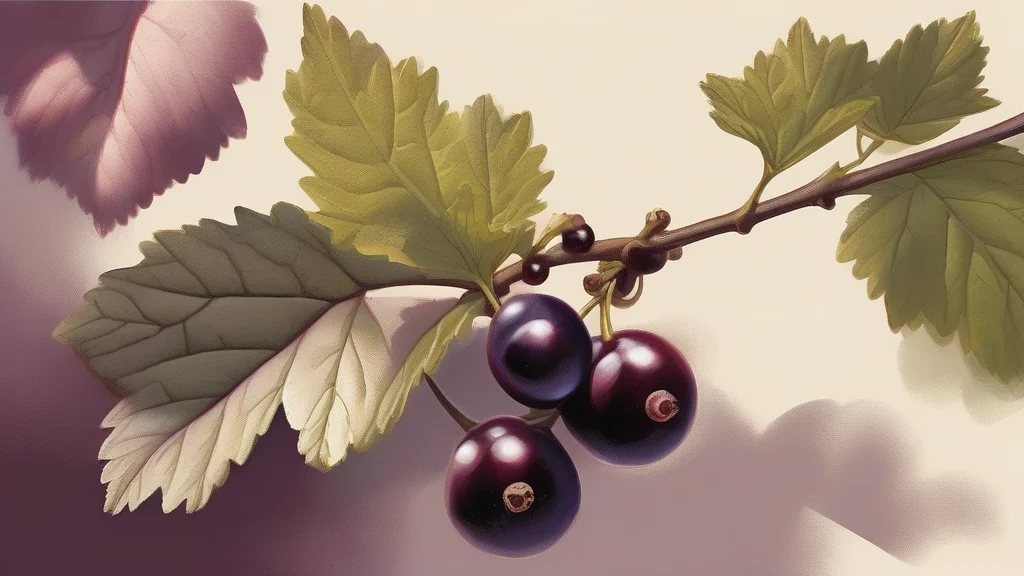
What does blackcurrant mean?
A blackcurrant is the small, deep-purple to black berry of Ribes nigrum, a hardy deciduous shrub native to Europe and parts of Asia. Intensely aromatic and sharply tart when raw, blackcurrants are rarely eaten fresh; instead they are transformed into jams, jellies, cordials, syrups, and the French liqueur known as crème de cassis. In British usage the word also functions as a familiar flavour label, appearing on everything from sweets to yoghurts, so that 'blackcurrant' evokes a distinctive sweet-sharp taste as much as a piece of fruit. The term is markedly more common in British and European English than American, reflecting the berry's long-standing popularity in Britain and its historical suppression in the United States, where planting was restricted for much of the twentieth century because blackcurrants can host white pine blister rust. The plural is blackcurrants, and the shrub bearing them may itself be called a blackcurrant.
nounA small, glossy black berry of the shrub Ribes nigrum, widely cultivated in Europe for its sharp, aromatic flavour; the shrub itself bears these berries.
- The small edible black berry of Ribes nigrum, valued for jams, cordials, liqueurs (notably crème de cassis), and desserts.
- The deciduous shrub (Ribes nigrum) that produces these berries.
"She stirred a spoonful of blackcurrant jam into her porridge on cold mornings."
"The cordial was made from blackcurrants picked at their darkest, ripest stage in late summer."
"He planted a row of blackcurrants along the north fence of the allotment."
Regular plural, used when referring to the fruits individually or collectively; uncountable use is uncommon except in processed contexts such as juice or purée.
"The recipe calls for 500 grams of blackcurrants, topped and tailed."
For decades blackcurrants were banned across much of the United States because they helped spread white pine blister rust — a fruit so feared it was outlawed.
Reviewed by Deb Chak, Editor. AI-assisted content curated by RJS Tech Solutions LLP.
Etymology of blackcurrant
The word 'blackcurrant' combines 'black' with 'currant', which entered English in the Middle Ages via Anglo-Norman and Old French 'corant', literally 'running', the present participle of 'courir', from Latin 'currere', meaning 'to run'. The name arose because the berries were associated with Corinth, whose grapes supplied the dried currants familiar to medieval traders. The compound 'blackcurrant' emerged by the early seventeenth century to distinguish this Ribes berry from both the dried-grape currant and the redcurrant. Its Latin root 'currere' survives in many English relatives, including 'current', 'courier', and 'course'.
How blackcurrant is actually used
The word is far more common in British and European English than in American English, where the fruit was long banned and remains comparatively unfamiliar. In culinary contexts 'blackcurrant' frequently appears attributively as a flavour descriptor (as in sweets, drinks, and desserts), often denoting a sweet-tart taste rather than the fresh fruit itself.
Easily confused with blackcurrant
A currant can mean a dried grape used in baking or a redcurrant/whitecurrant of the genus Ribes, whereas a blackcurrant specifically denotes the black berry of Ribes nigrum.
A blackberry is an aggregate fruit of brambles in the genus Rubus, larger and sweeter than the sharp, strongly aromatic blackcurrant.