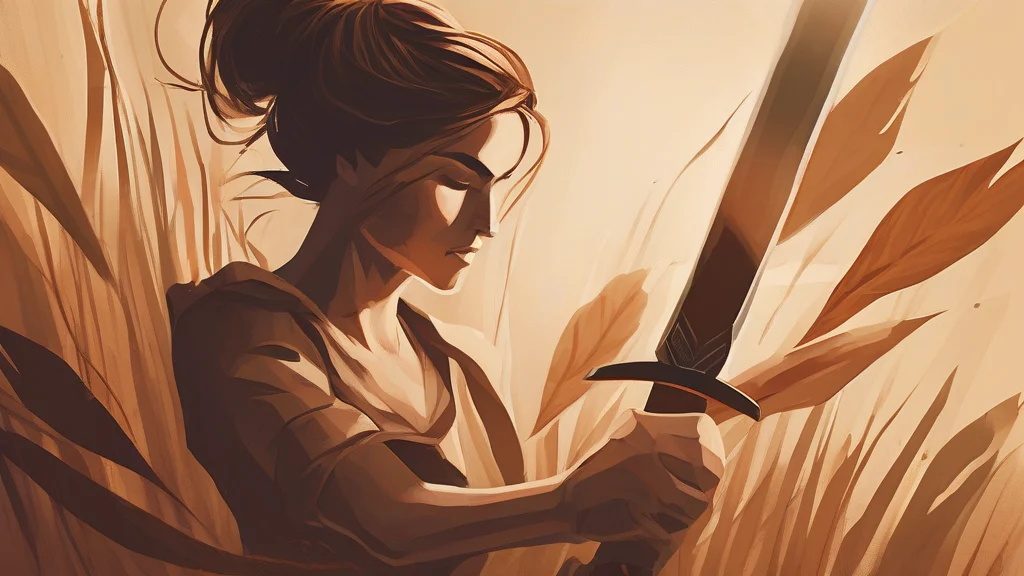
What does bladed mean?
Bladed is an adjective describing something that possesses a blade — a flat, thin component with a sharp edge — or that resembles such a shape. Its most familiar use is with weapons: swords, knives, and daggers are all bladed implements whose effectiveness depends on their honed edges. The word extends naturally into engineering, where propellers, fans, and turbines are described as single-bladed, double-bladed, or multi-bladed depending on how many aerodynamic surfaces they carry. Botanists also apply the term to foliage, since many grasses and irises bear long, narrow, blade-shaped leaves. Connotations vary with context: neutral and technical when discussing machinery, but faintly ominous when describing arms, since 'bladed' implies an instrument designed to cut. Derived from the noun 'blade', which entered Middle English from Old English 'blæd' meaning a leaf or flat part, the word is a useful descriptive term wherever thinness and sharpness matter. It appears frequently in product descriptions, fantasy fiction, historical writing, and technical manuals alike.
adjectiveHaving a blade or blades, especially flat, thin, sharp-edged ones; fitted or armed with a blade. Also used to describe leaves or grass that are long, narrow, and blade-shaped.
- Having a blade or blades; equipped with one or more cutting edges (e.g. a bladed weapon, a multi-bladed propeller).
- (Of leaves or plants) having long, narrow, sword-like foliage.
"The skater glided across the frozen lake on bladed boots."
"The museum displayed an array of ancient bladed weapons, from daggers to broadswords."
"The ornamental grass produced tall, bladed fronds that rustled in the wind."
A helicopter's rotor can have several 'blades', but once you attach them it becomes a bladed machine — one of the few words where adding a suffix to an already concrete noun makes the picture even more vivid.
Reviewed by Deb Chak, Editor. AI-assisted content curated by RJS Tech Solutions LLP.
Etymology of bladed
The adjective 'bladed' derives from the English noun 'blade', which traces back through Middle English to Old English 'blæd', originally meaning a leafing shoot or the leaf of a plant. Over time the sense narrowed to describe any flat, thin, edged instrument — hence knife blades, sword blades, and eventually the blades of oars, propellers, and turbines. The suffix '-ed' simply marks possession: to be bladed is to be furnished with a blade or blades. Related forms include 'bladebone' (the shoulder blade) and the compound 'bladesmith', reflecting the word's deep association with both nature and craftsmanship.
How bladed is actually used
'Bladed' is most often found in technical or descriptive contexts — weaponry, engineering (propellers, turbines), and botany. In compounds like 'single-bladed' or 'double-bladed', the number usually precedes the adjective. It carries a neutral-to-slightly-menacing connotation when applied to weapons.
Easily confused with bladed
'Bladed' means having a blade or blades; 'balded' is a rare verb form meaning made bald and is not a standard adjective.