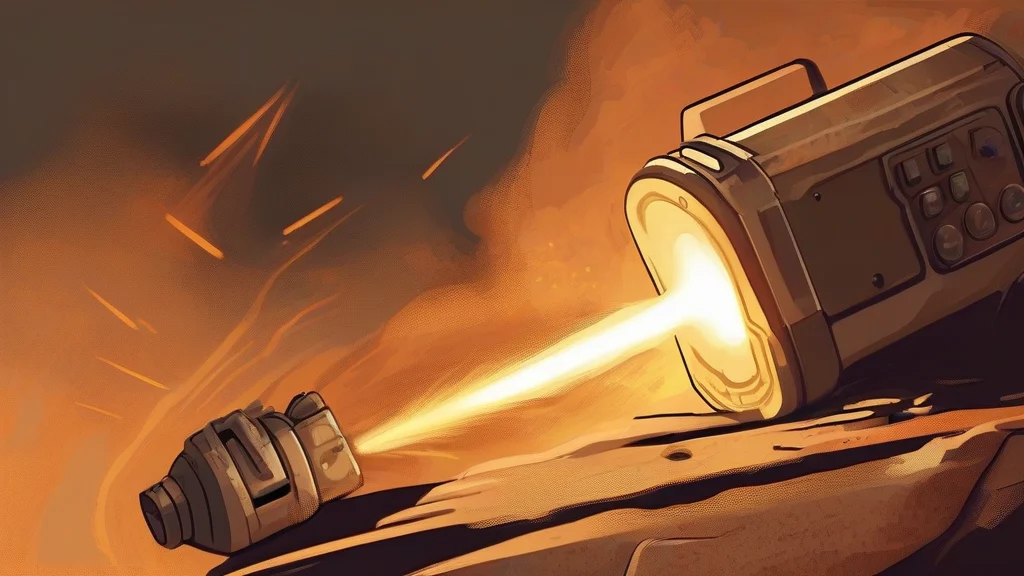
What does blaster mean?
A blaster is, at its most literal, something that blasts: an explosive charge set off in mining or demolition, or a machine that projects a forceful stream of material such as sand or water. The word has also taken on a vivid second life in popular culture, where it names the handheld energy weapons of science fiction — devices that fire destructive rays instead of bullets. This fictional sense, cemented by films such as Star Wars, is now arguably the association many English speakers reach for first. In everyday technical use, compounds like sandblaster describe equipment that cleans or shapes surfaces by blasting them with abrasive particles, and informally a 'blaster' can even be a very loud speaker or sound system. The word carries connotations of power and force rather than subtlety, and it sits comfortably between industrial jargon and playful genre fiction, making it a useful term wherever sudden, concentrated energy is being described.
nounA device or person that blasts, especially an explosive charge used in mining or demolition, or a powerful loudspeaker. In science fiction, a blaster is a handheld energy weapon that fires destructive rays.
- An explosive charge or device used to detonate material in mining, quarrying, or demolition.
- In science fiction, a handheld weapon that fires destructive energy beams.
- A machine that directs a forceful stream of air, water, or abrasive particles (e.g. sandblaster).
- Informally, a very powerful loudspeaker or sound system.
"The miners set the blaster before clearing out of the tunnel."
"The engineer wired up the blaster and signalled everyone to retreat to a safe distance."
"He levelled his blaster at the approaching drone and fired."
Regular plural; used identically across all senses.
"The armoury contained a rack of worn blasters."
Long before it fired laser beams in Star Wars, 'blaster' was the unglamorous name for the explosive charges miners used to blow rock apart.
Reviewed by Deb Chak, Editor. AI-assisted content curated by RJS Tech Solutions LLP.
Etymology of blaster
Blaster is formed from the verb 'blast', which entered English from Old Norse 'blastra', meaning to blow or make a roaring wind, combined with the agentive suffix '-er'. It originally denoted a person or thing that sets off explosions, appearing in industrial contexts by the nineteenth century. Its science-fiction sense developed in twentieth-century American pulp magazines and was widely popularised by film. Cognate forms include 'blast' itself and related Germanic words for blowing and gusting.
Related word forms
How blaster is actually used
The word is informal to neutral in register. Its dominant modern cultural association is with science fiction weaponry, though industrial senses remain current. The plural is straightforwardly 'blasters'.
Easily confused with blaster
'Blustering' refers to loud, aggressive, wind-like talk or behaviour, whereas a 'blaster' is a device (or person) that causes explosions or emits blasts.