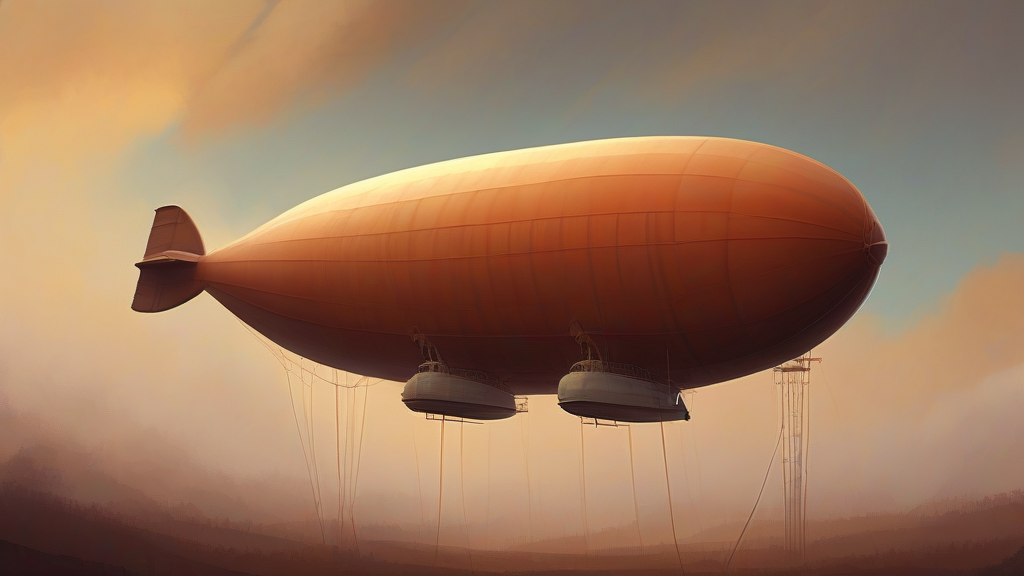
What does blimp mean?
A blimp is a small non-rigid airship — an aircraft that floats because its envelope of fabric is filled with a gas lighter than air, such as helium. Unlike rigid airships such as zeppelins, a blimp has no internal framework; it holds its shape only through the pressure of the gas inside, which is why it looks soft-edged and slightly sagging when deflated. Blimps are familiar today mainly as advertising platforms and camera platforms hovering over sporting events. The word has a second, figurative life in British English especially: a "blimp" is a pompous, old-fashioned person who resists change, after Colonel Blimp, the jingoistic cartoon character created by David Low in the 1930s. This sense produced the adjective "blimpish," meaning stubbornly conventional. The word's ultimate origin is uncertain — one popular theory links it to a military design code, "Type B limp" — making it one of those rare English words whose birth nobody can quite pin down.
A small non-rigid airship consisting of an inflated fabric envelope without an internal frame.
"The blimp circled above the racetrack, trailing an advertising banner."
(Informal) A pompous, elderly, or ultra-conservative person who resists social or political change.
"Critics called him a blimp out of touch with the modern party."
Standard pluralization applies; the plural refers almost exclusively to multiple airships, since the figurative sense usually appears in the singular.
"Two blimps hovered over the harbor during the fleet review."
"Blimp" may have been coined from a military inspection code — "Type B limp" — for a non-rigid airship's floppy envelope, though the true story remains one of aviation's favorite mysteries.
Reviewed by Deb Chak, Editor. AI-assisted content curated by RJS Tech Solutions LLP.
Etymology of blimp
The origin of "blimp" is genuinely disputed, which makes it unusual among common words. It appeared around the time of the First World War, when non-rigid airships were being developed in Britain, and the most widely cited theory is that it derives from a designation used in airship construction — "Type B limp" — referring to a class B envelope with no rigid structure. Other accounts attribute it to a coinage at a British airfield, possibly involving a playful flick of the fingers against taut fabric. Whatever its exact birth, the term spread quickly into general use, and in the 1930s the cartoonist David Low added a second meaning with his character Colonel Blimp, giving rise to the figurative senses and to "blimpish." No secure cognates in other languages are established, since the word's derivation itself remains unresolved.
Related word forms
How blimp is actually used
The airship sense is neutral in register. The figurative sense is informal and mildly derogatory; it derives from David Low's cartoon character Colonel Blimp, whose name also spawned the adjectives "blimpish" and "blimpishness."
Easily confused with blimp
A dirigible is any steerable lighter-than-air craft including rigid types like zeppelins, while a blimp specifically has no internal frame and keeps its shape purely through gas pressure.