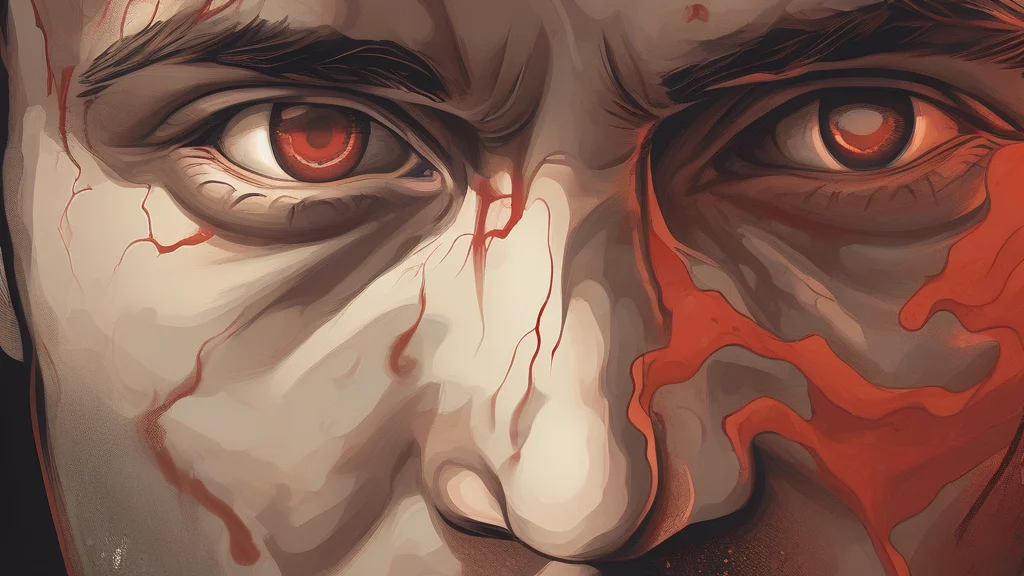
What does bloodshot mean?
"Bloodshot" is an adjective describing eyes whose normally white sclera has become red or pink because the small blood vessels near the surface have widened. The condition — and the word for it — typically signals fatigue, lack of sleep, eye strain, exposure to irritants such as smoke, allergic reactions, heavy crying, or the effects of alcohol. In practice the word rarely travels far from its most natural companion: it overwhelmingly appears in the phrase "bloodshot eyes," whether describing a weary traveler at an airport, a character who has been up all night, or someone recovering from a long evening. It belongs to neutral, everyday English rather than any formal or technical register, and writers frequently use it as economical shorthand to suggest exhaustion or emotional distress without naming the cause. Because it conveys physical evidence of a state — visible redness that others can see — "bloodshot" adds a concrete, telling detail to descriptions of people and remains a small but reliably vivid part of the descriptive vocabulary.
adjectiveDescribing eyes in which the white portion is reddened because the small blood vessels are dilated, typically as a result of fatigue, strain, irritation, or crying.
- (Of eyes) having reddened whites due to dilated blood vessels, typically from fatigue, irritation, alcohol, or weeping.
"She rubbed her bloodshot eyes and reached for another cup of coffee."
"After the overnight flight, his bloodshot eyes betrayed how little sleep he had gotten."
"The referee's bloodshot gaze swept the room, looking for anyone who might challenge the call."
Your eyes don't actually bleed when they're bloodshot — tiny vessels just swell up with extra blood, turning the white of your eye into a warning light for tiredness, tears, or a very long night.
Reviewed by Deb Chak, Editor. AI-assisted content curated by RJS Tech Solutions LLP.
Etymology of bloodshot
"Bloodshot" is a compound formed from "blood" and the past participle of "shoot," first appearing in English writing in the early seventeenth century. The verb "shoot" here reflects its older, broader sense of sending forth or darting out — so a bloodshot eye was imagined as one whose blood had shot out into the visible surface. The formation is entirely native to English, drawing on Germanic roots shared with words like "blood" itself and the common Germanic verb behind "shoot."
How bloodshot is actually used
Almost always used attributively before "eyes" (as in "bloodshot eyes"); predicative use ("his eyes were bloodshot") is also common. The word carries no strong register — it appears equally in everyday speech, journalism, and fiction — and often implies tiredness, drinking, crying, or strain without stating the cause explicitly.
Easily confused with bloodshot
"Bloodshot" describes redness of the eyes caused by dilated vessels, while "bloodstained" means covered or marked with actual blood.