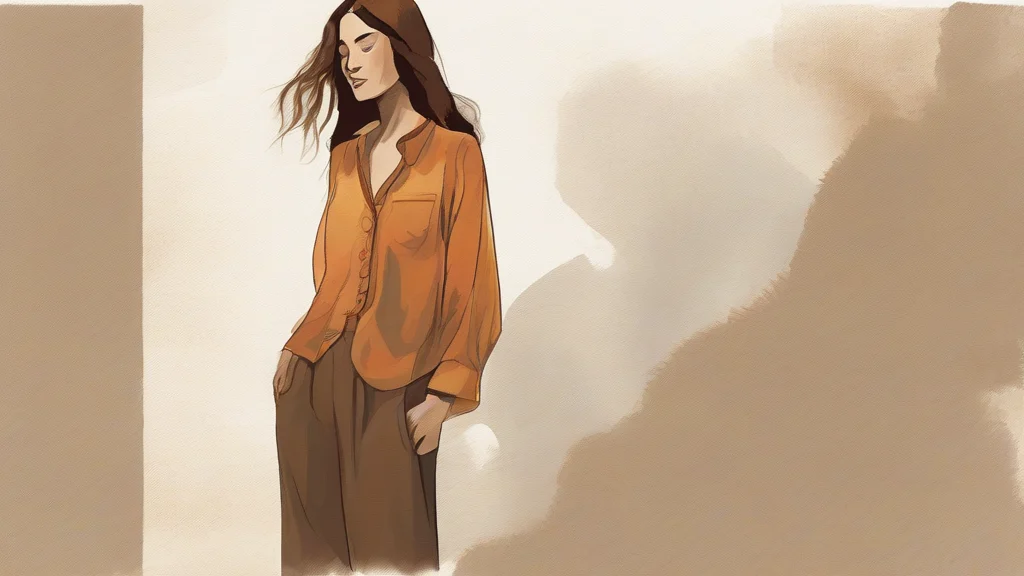
What does blouse mean?
A blouse is a loose, shirtlike garment covering the upper body, most commonly worn by women and girls today. Typically fastened with buttons down the front, it may be made of fabrics ranging from crisp cotton to flowing silk, and it occupies a place between casual wear and formal attire — a tailored blouse under a jacket is a staple of professional dress. The word entered English from French, where "blouse" originally denoted the loose linen smock worn by peasants and laborers; that older sense lingers mainly in historical contexts. English also uses "blouse" as a verb, almost entirely in military slang, meaning to gather one's trouser legs so they billow over the top of the boots. With its blend of everyday practicality and sartorial elegance, "blouse" remains a standard term in fashion, retail, and daily conversation about clothing.
A loose garment for the upper body, typically buttoned at the front and now worn chiefly by women and girls.
"She paired her navy blouse with tailored trousers."
Historically, also the loose smock of a workman or peasant; this sense is now largely obsolete except in historical description.
To arrange (trouser legs) so they hang loosely and billow over the top of boots, especially as part of a military uniform.
"The recruits were instructed to blouse their trousers over their jump boots."
Rare outside military usage.
Standard plural; used both when referring to multiple garments and collectively, as in retail inventory.
"The boutique displayed its summer blouses in the front window."
"Blouse" began as the working man's garment — French peasants and laborers wore them centuries before it became shorthand for office-ready women's fashion.
Reviewed by Deb Chak, Editor. AI-assisted content curated by RJS Tech Solutions LLP.
Etymology of blouse
"Blouse" comes from the French word of the same spelling, which referred to the loose blue linen smock worn by French peasants and workmen. The word passed into English in the early nineteenth century, first carrying that sense of a laborer's loose garment before shifting to denote women's shirtlike garments as women's fashion adopted the style. It is related to the French diminutive "blouson," used for a short, blousy jacket.
Related word forms
How blouse is actually used
In contemporary usage, "blouse" refers almost exclusively to women's or girls' shirts, often implying a softer or dressier style than a plain shirt. The historical sense of a peasant's or worker's loose smock survives mainly in historical writing. The verb form is rare outside military contexts.