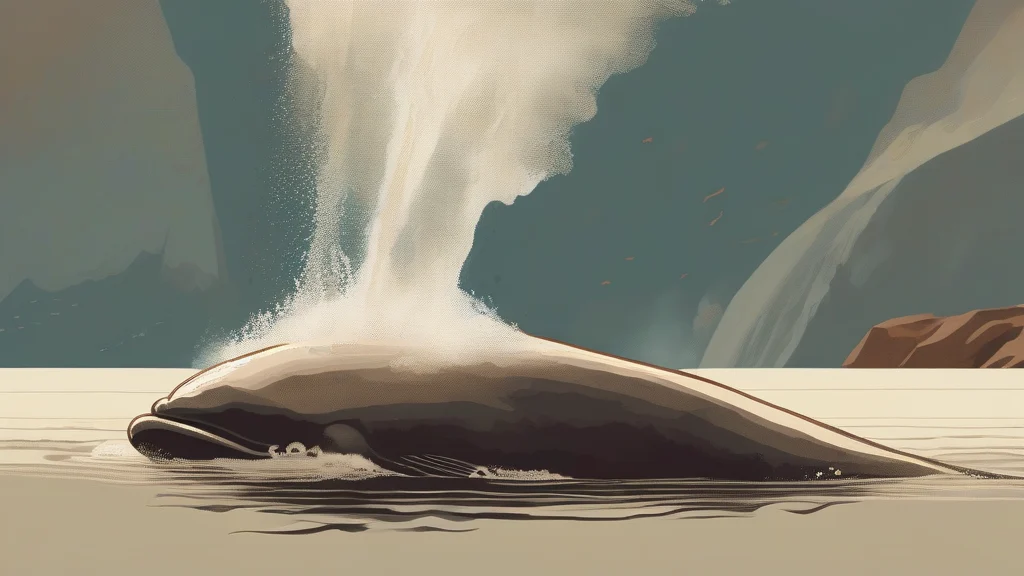
What does blowhole mean?
A blowhole is a specialised opening, most famously found on the top of the heads of whales, dolphins, and porpoises, that serves as their nostril and allows them to breathe air while remaining mostly submerged. When a cetacean surfaces, it forcefully exhales through the blowhole, producing the distinctive plume or "spout" of water vapour familiar to whale watchers. In a separate but related sense, a blowhole also describes a natural vent in coastal rock through which waves compress air and water, sending dramatic sprays skyward; famous examples occur along volcanic shorelines in Hawaii and Australia. The word combines "blow," meaning to force air out, with "hole," and functions as an everyday noun across both scientific and casual registers. It carries no strong emotional connotation, though the sight of a spouting whale or an erupting sea vent tends to evoke wonder, making the word a favourite in nature documentaries and travel writing alike.
An external nostril located on the top of the head of whales, dolphins, and porpoises, used for breathing.
"Dolphins are voluntary breathers, consciously deciding each time they surface to open the single blowhole atop their heads."
Baleen whales have two blowholes; toothed whales have one.
A natural opening in rock, typically along a coast, through which air or seawater is forced upward by wave action or tides.
"At high tide, the Kiama Blowhole sends seawater shooting nearly twenty-five metres into the air."
Regular plural formation; commonly used when describing multiple cetaceans or several coastal vents.
"Several blowholes dot the rugged shoreline, each roaring to life as the swell builds."
A whale can hold its breath for over an hour — then exhales in one explosive blast through its blowhole at speeds of up to hundreds of miles per hour.
Reviewed by Deb Chak, Editor. AI-assisted content curated by RJS Tech Solutions LLP.
Etymology of blowhole
Blowhole is formed transparently from the native English words "blow" and "hole," reflecting its function as an opening from which air is expelled. It emerged in English usage during the seventeenth century, initially applied to vents in rocks and later to the breathing apertures of cetaceans as whaling and marine observation expanded. As a compound of two common Germanic roots, it shares its components with countless other English words rather than belonging to a broader Latin- or Greek-derived family.
How blowhole is actually used
"Blowhole" is a neutral, descriptive term common in both scientific marine-biology writing and popular nature contexts. When referring to cetaceans it is standard terminology; when referring to coastal rock features it often appears in tourist and geographical descriptions, particularly in places like Australia, Hawaii, and Cornwall.
Easily confused with blowhole
A spiracle is the comparable breathing opening found in cartilaginous fish such as sharks and rays, whereas a blowhole refers specifically to cetaceans (whales, dolphins, and porpoises).