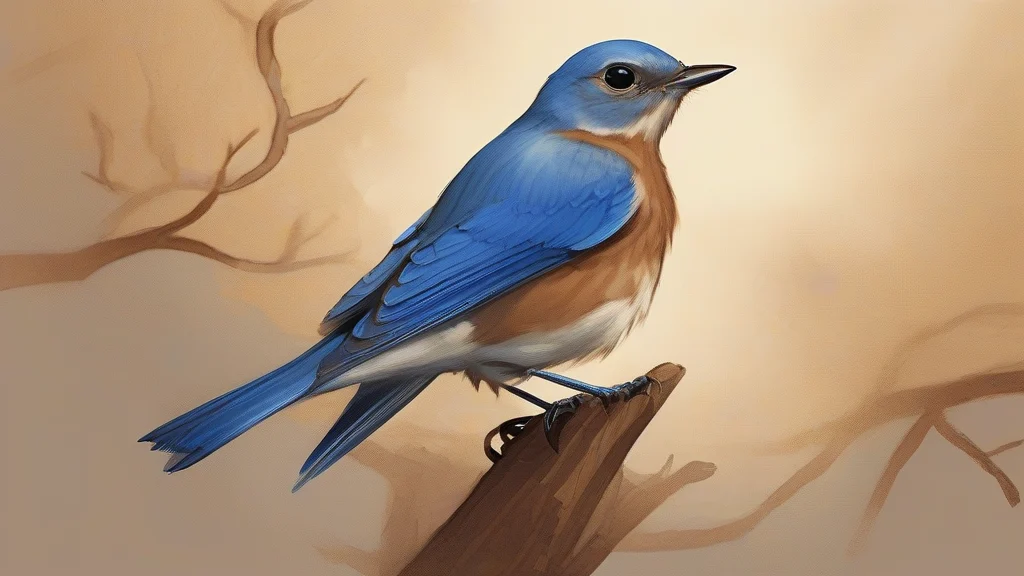
What does bluebird mean?
A bluebird is one of three species of small North American songbirds in the thrush family Turdidae, genus Sialia: the eastern, western, and mountain bluebird. Males are strikingly colored in shades of blue, often with rusty-orange breasts, while females are grayer with hints of blue on the wings and tail. Bluebirds favor open country, orchards, and woodland edges, where they feed mainly on insects and berries and readily nest in boxes provided by humans — a practice encouraged because their populations declined with habitat loss. Beyond ornithology, the word has strong cultural resonance: the bluebird is a long-standing emblem of happiness, hope, and good fortune, appearing in folklore, poetry, and popular songs such as the 'bluebird of happiness.' Because of this dual life as both a real bird and a cherished symbol, 'bluebird' is a word that carries warmth wherever it is used.
nounA small North American songbird of the thrush family, the males of which have bright blue or partly blue plumage; any of three species in the genus Sialia.
- A small North American thrush of the genus Sialia, with blue (male) or grayish-blue plumage and a cheerful warbling song.
- A traditional symbol of happiness and good fortune in folklore, literature, and popular culture.
"An eastern bluebird perched on the fence post, its rust-colored breast catching the morning light."
"We watched a pair of bluebirds carry nesting material into the box by the meadow."
"In the old song, the 'bluebird of happiness' appears just when things seem darkest."
Regular plural; used when speaking of multiple individuals or more than one species collectively.
"Dozens of bluebirds gathered along the hedgerow before migration."
The bluebird is so beloved as a symbol of happiness that it serves as the official state bird of both Missouri and New York.
Reviewed by Deb Chak, Editor. AI-assisted content curated by RJS Tech Solutions LLP.
Etymology of bluebird
Bluebird is a straightforward English compound formed from 'blue,' from Old French bleu, ultimately of Germanic origin, plus 'bird.' The compound arose naturally to describe the vividly colored North American thrushes encountered by English speakers in the Americas, with early written attestations dating back several centuries. Its component 'blue' is shared with many other common compounds such as blueberry, blueprint, and bluebell.
How bluebird is actually used
The word is used both for the actual birds and figuratively for joy or good luck, especially in songs and literature. It is informal-to-neutral in register and carries warm, positive connotations. In British English it refers mainly to the symbolic or literary sense, since true bluebirds are native to the Americas.
Easily confused with bluebird
A blackbird is a mostly black Eurasian or American songbird, whereas a bluebird is a North American thrush with bright blue male plumage.
The bluetit is a small Eurasian bird with blue and yellow markings, not related to the North American bluebird.