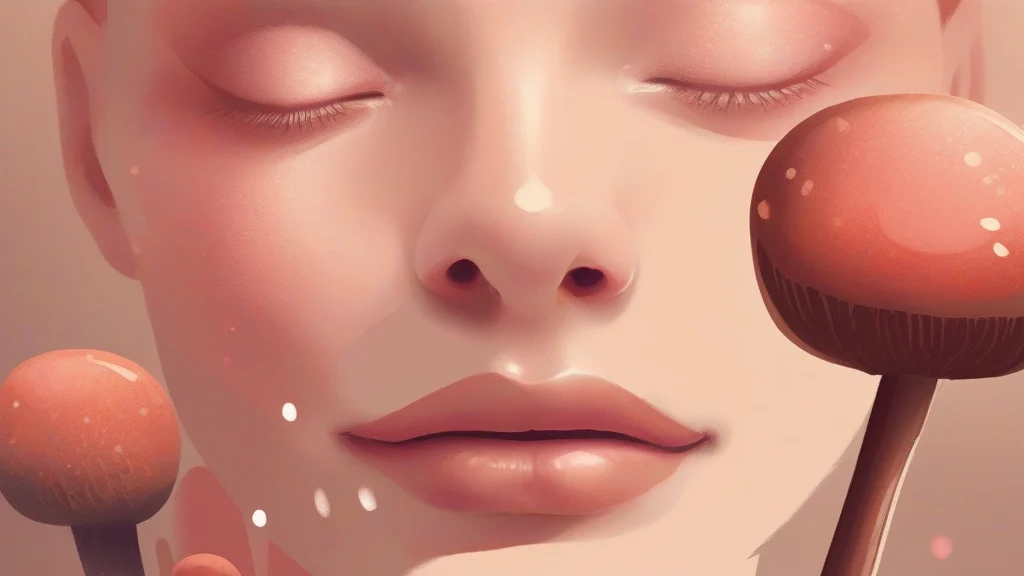
What does blusher mean?
A blusher is a cosmetic product — typically a pressed powder, cream, or liquid — applied to the cheeks to lend them a natural-looking flush of colour. The word derives from 'blush', capturing the way good blusher mimics the healthy redness that rises in the face during exercise, warmth, or mild embarrassment. It is a staple of makeup kits worldwide: British English strongly favours 'blusher' for the product itself, while American usage tends to shorten this to 'blush'. By extension, a blusher can be a person who blushes readily, a lighthearted label for anyone whose face turns pink at the slightest compliment or awkward moment. Less familiarly, in Britain 'the blusher' is the common name of a woodland mushroom, Amanita rubescens, which earns its name by staining pinkish-red where it is cut or handled. Compact, descriptive, and rooted in a universal human experience, the word neatly bridges beauty counters, casual conversation, and forest floors alike.
A powder or cream used to add rosy colour to the cheeks.
"The compact contained a mirror and a peach-toned blusher."
Standard in British English for the cosmetic; American English commonly uses 'blush' instead.
A person who blushes readily or often.
"An incorrigible blusher, she dreaded being called on in class."
Informal, agentive use of the suffix '-er'; less frequent than the cosmetic sense.
(British English) The blusher mushroom, Amanita rubescens, whose flesh stains pinkish-red when cut or bruised.
"Foragers prize the blusher, though it must be cooked thoroughly before eating."
Chiefly used among British mycologists and mushroom foragers.
Regular plural. Used when referring to multiple cosmetic products or multiple people who blush; rarely needed for the mushroom sense except when counting specimens.
"Her dressing table was crowded with blushers in every shade from apricot to plum."
The same word that names a pretty pink powder also names a woodland mushroom that 'blushes' pink when you slice it open.
Reviewed by Deb Chak, Editor. AI-assisted content curated by RJS Tech Solutions LLP.
Etymology of blusher
Blusher is formed from the verb 'blush', which traces back to Old English 'blyscan', meaning to glow or redden, combined with the agentive suffix '-er'. The cosmetic sense arose by extension from the idea of artificially producing the facial flush that gives the word its root meaning. The mushroom sense applies the same idea literally: the fungus visibly reddens when bruised, so it too became 'a thing that blushes'. Cognates within English include the related forms 'blush', 'blushing', and 'blushful', all sharing the same Germanic root.
How blusher is actually used
In everyday usage, especially in beauty contexts, 'blusher' is the standard term in British English, while American speakers more often say simply 'blush' for the cosmetic. The sense referring to a person who blushes easily is formed with the common agentive suffix '-er' and is informal. In British mycological and foraging circles, 'the blusher' is a well-known name for Amanita rubescens.
Easily confused with blusher
Blush is primarily a verb meaning to redden in the face from embarrassment (and a noun for that flush), whereas a blusher is either the cosmetic product or a person who blushes readily.
A brusher is one that brushes; despite the near-identical sound, it has no connection to cosmetics or to reddening.