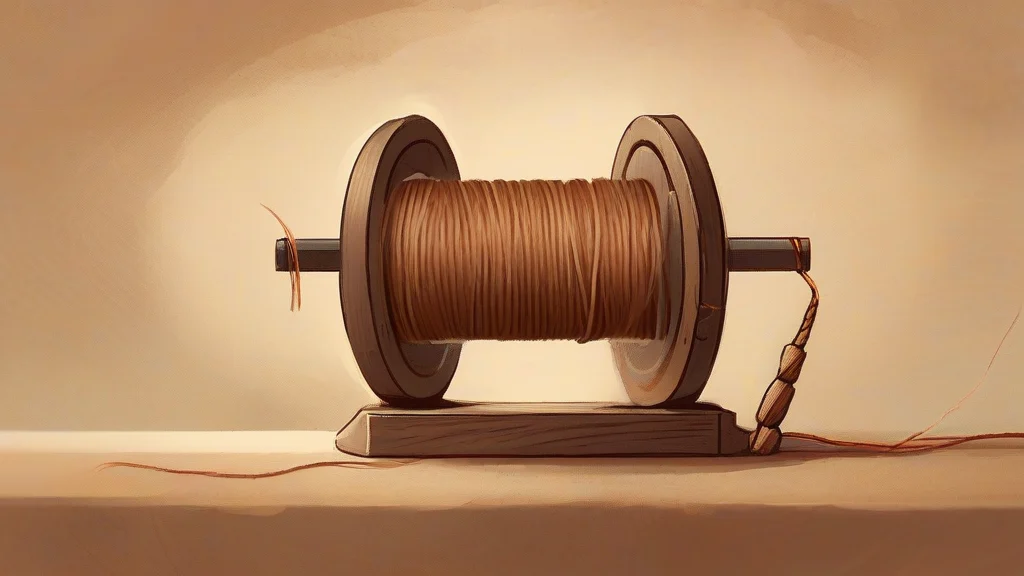
What does bobbin mean?
A bobbin is a small cylindrical spool — usually of wood, plastic, or metal — onto which thread, yarn, or wire is wound. The word appears most often in sewing contexts: in a lockstitch sewing machine, the bobbin holds the lower thread that interlocks with the upper thread from the needle to form each stitch. Bobbins also play an essential role in traditional crafts; in bobbin lace-making, dozens of weighted bobbins are twisted and crossed to build intricate patterns, a technique long associated with English towns such as Nottingham. Related terms include spool, reel, and spindle, though these are broader or context-specific. The word carries no strong connotation — it is practical, domestic, and slightly old-fashioned in feel, evoking both home sewing kits and historic textile mills. Because it names a concrete, everyday object with a precise technical role, bobbin remains a useful word for anyone writing about crafts, clothing manufacture, or textile machinery, and it survives as living vocabulary wherever thread is still wound by hand or by machine.
nounA bobbin is a small cylindrical spool, typically made of wood, plastic, or metal, on which thread, yarn, or wire is wound. It most commonly refers to the spool holding thread in a sewing machine or the one used in lace-making.
- A small spool on which thread, yarn, or wire is wound, especially the lower-thread spool of a sewing machine.
- A spool used in lace-making ('bobbin lace') or textile weaving.
"She replaced the empty bobbin in her sewing machine before continuing to stitch the hem."
"The tailor threaded a fresh bobbin and set it into the shuttle of the machine."
"In the museum workshop, visitors watched lacemakers twist dozens of bobbins into delicate patterns of bobbin lace."
Standard plural; used freely when referring to multiple spools, e.g. a box of spare bobbins for a sewing kit.
"The craft shop sold packs of ten plastic bobbins in assorted colours."
The humble bobbin has been quietly holding civilisation's clothes together since the Middle Ages — and whole towns like Nottingham grew rich on 'bobbin lace'.
Reviewed by Deb Chak, Editor. AI-assisted content curated by RJS Tech Solutions LLP.
Etymology of bobbin
Bobbin entered English in the early 16th century, likely as a diminutive formed from 'bob', a Middle English word of uncertain deeper origin meaning something short, round, or hanging. The suffix '-in' gives it a diminutive quality, fitting for a word describing a small spool. Its development is tied closely to the growth of the textile trades in England and Europe, where specialised vocabulary for spinning, weaving, and lacemaking flourished from the medieval period onward. Cognate forms built on the same root 'bob' appear in related English words such as 'bobbed' and 'bobtail', all sharing the sense of something small, rounded, or dangling.
How bobbin is actually used
Bobbin is a neutral, technical-to-everyday term common among sewists, quilters, weavers, and lacemakers. In British English it also appears in the compound 'bobbin lace', a traditional craft strongly associated with regions such as Nottinghamshire. It is rarely used figuratively; its register ranges from domestic conversation to industrial textile terminology.
Easily confused with bobbin
A spool is a more general term for any reel-like object holding thread or film, whereas a bobbin specifically refers to the small spools used inside sewing machines or in lace-making and weaving.
A shuttle carries the weft thread back and forth across a loom and often contains or passes a bobbin, but the shuttle itself is not the bobbin.