What does bogy mean?
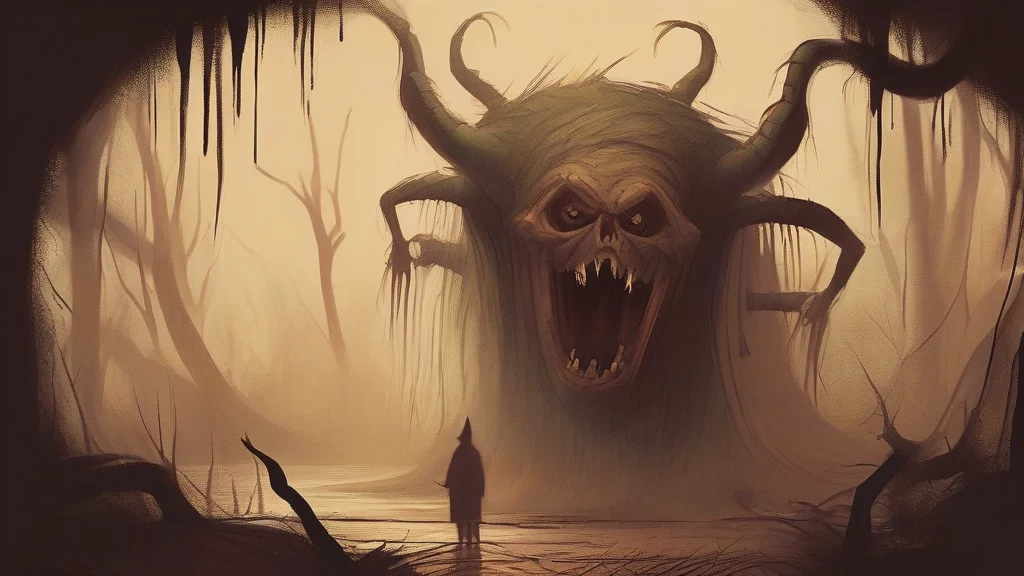
A bogy is a malevolent or terrifying supernatural being — essentially an evil spirit — or, by extension, any persistent source of dread that looms large in the imagination. The word functions almost interchangeably with its far more common variant spelling 'bogey', and both trace back to the same family of old words for goblins and bugbears that haunted English folklore. In practice, 'bogy' today appears mostly in older or literary writing, where authors speak of raising the bogy of some threat — war, debt, disease — to describe how an abstract fear is invoked to alarm people. Because it sounds identical to 'bogie', the technical term for a railway wheel assembly and the golf score meaning one over par, the spelling invites frequent confusion. For readers encountering historical texts or British writing, knowing 'bogy' helps decode references to phantoms and personified terrors that more modern vocabulary would simply call fears or nightmares.
nounAn evil or frightening spirit; a source of persistent, often irrational dread. Also a variant spelling of 'bogey', used for a recurring imagined menace or obstacle.
- An evil or frightening spirit; something feared as a haunting presence
- A persistent imagined source of fear or anxiety (e.g. 'the bogy of unemployment')
"Inflation became the bogy that haunted every government budget meeting."
"The children were convinced a bogy lurked in the attic after dark."
"Politicians kept invoking the bogy of foreign invasion to rally support."
Regular pluralization; note this is spelled the same as the plural of 'bogie' (railway wheel assembly), so context must disambiguate.
"Old folktales are full of bogies that punish disobedient children."
Reviewed by Deb Chak, Editor. AI-assisted content curated by RJS Tech Solutions LLP.
Etymology of bogy
'Bogy' derives from the same Middle English roots as 'bogey' and 'bugbear' — words for goblins and frightful spirits found in British folklore from at least the medieval period. It belongs to a family of terms including 'bogle', Scottish in origin, and 'bugaboo', all denoting imaginary creatures used to frighten children. The spelling variants diverged over centuries, with 'bogey' eventually becoming dominant while 'bogy' persisted as a less common alternative.
Related word forms
How bogy is actually used
'Bogy' is now largely superseded by 'bogey' in modern usage and may read as dated or literary. The plural is 'bogies'. Do not confuse with the identically pronounced 'bogie' of rail transport.
Easily confused with bogy
A 'bogie' is the wheeled undercarriage of a train or the golf term for one stroke over par, whereas a 'bogy' is an evil spirit or object of fear.
'Bogey' is the more common spelling for both the evil-spirit sense and the golf sense, while 'bogy' is chiefly a variant used for the spirit/dread meaning.