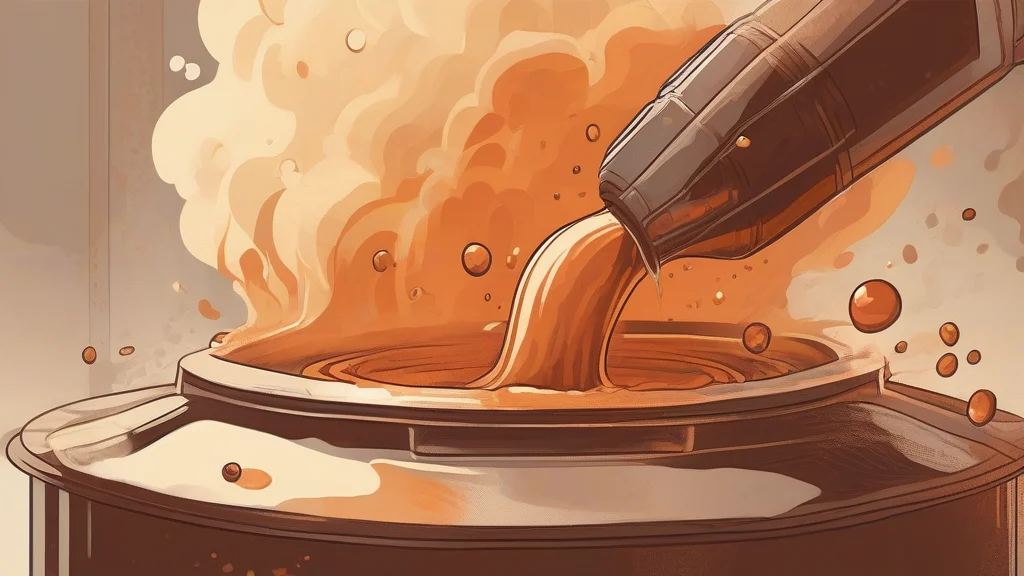
What does boilover mean?
A boilover is the uncontrolled overflow of a boiling liquid from its container, occurring when vigorous bubbling or foaming lifts the liquid's surface until it spills over the rim. The word is most familiar in domestic settings: a pot left unattended on a stove can produce a starchy, sizzling boilover that fouls the cooktop. Beyond the kitchen, however, boilover carries a serious technical meaning. In firefighting and petrochemical engineering it names a dangerous phenomenon in which burning oil in a storage tank suddenly erupts because a layer of water beneath the oil becomes superheated and flashes into steam, expelling burning fuel violently. This dual usage gives the word an unusual range: homely in one context, hazardous in another. Its connotations are generally negative — mess, waste, or danger — and it functions as a concrete noun, pluralized as boilovers.
An overflow of boiling liquid from its container, caused by bubbling or foaming.
"A quick stir and a lower flame will stop the milk from causing a boilover."
Informal but standard in everyday speech about cooking.
In firefighting, the violent eruption of burning oil from a storage tank when a superheated water layer beneath it vaporizes.
"The crew monitored the tank closely for signs of an impending boilover."
Technical term in fire science and petrochemical safety.
Standard regular plural, used when referring to multiple instances of the phenomenon.
"Lids and wooden spoons across pots can prevent most boilovers."
In oil-tank fires, firefighters dread the 'boilover' — a superheated water layer beneath burning crude can erupt explosively, hurling flames hundreds of feet into the air.
Reviewed by Deb Chak, Editor. AI-assisted content curated by RJS Tech Solutions LLP.
Etymology of boilover
Boilover is formed by compounding the native English verb 'boil,' which derives from Old French 'boillir' and ultimately Latin 'bullire' (to bubble), with the adverbial element 'over.' As a compound, it arose naturally in English to describe liquids boiling over their containers, with the term recorded in practical use by at least the nineteenth century. The specialized firefighting sense developed in the twentieth century alongside the growth of large-scale petroleum storage, borrowing the everyday compound for a precisely defined industrial hazard.
How boilover is actually used
Most common in everyday kitchen contexts, where it is informal but widely understood. The industrial sense is technical vocabulary used in firefighting and petrochemical safety literature.
Easily confused with boilover
An overflow is any spilling of liquid beyond a container's capacity, whereas a boilover specifically results from boiling or foaming action that drives the liquid up and out.