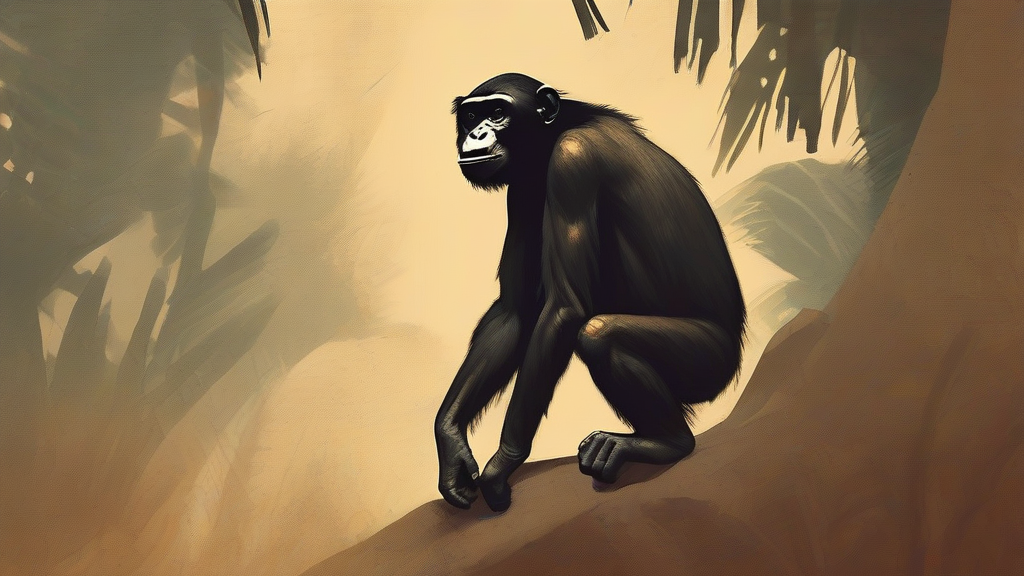
What does bonobo mean?
The bonobo is a species of great ape, Pan paniscus, native exclusively to the rainforests of the Democratic Republic of the Congo in Central Africa. Long mistaken for a small chimpanzee, it was recognised as a distinct species in the twentieth century and is now classified alongside the chimpanzee as humanity's closest living relative. Bonobos are slender, dark-faced apes that live in groups notable for their remarkably low levels of aggression; conflicts are typically defused through grooming, sharing, and reassuring physical contact, and females often hold high status within the group. Because of these traits, the bonobo has become a symbol of peaceful coexistence in both scientific writing and popular culture. The word itself functions as a noun and appears most often in contexts of primatology, evolution, and conservation, since habitat loss and poaching have left the species endangered in the wild.
nounA bonobo is a rare, slender great ape (Pan paniscus) found only in the forests of the Democratic Republic of the Congo, closely related to and resembling the chimpanzee but smaller and darker-faced. It is noted for its peaceful, cooperative social behaviour and frequent use of sexual contact to ease tensions within groups.
- The great ape Pan paniscus, endemic to the Democratic Republic of the Congo, distinguished from the common chimpanzee by its smaller size and notably peaceful, matriarchal social structure.
"Unlike chimpanzees, bonobos resolve conflicts through grooming and reassurance rather than violence."
"Researchers observed a group of bonobos sharing food peacefully around a fallen fig tree."
"As one of humanity's closest relatives, the endangered bonobo has become an emblem of primate conservation."
Standard English plural, formed regularly with -s. The word is countable when referring to individual animals.
"Only about ten thousand bonobos remain in their native Congolian forests."
Bonobos are our closest living relatives alongside chimpanzees — yet where chimps wage war, bonobos famously 'make love, not war'.
Reviewed by Deb Chak, Editor. AI-assisted content curated by RJS Tech Solutions LLP.
Etymology of bonobo
The word 'bonobo' entered English in the mid-twentieth century as the accepted common name for the ape then known as the pygmy chimpanzee. Its ultimate origin is uncertain: it is generally believed to be an African name of local provenance, and one widely repeated account holds that it arose from a misreading of 'Bolobo', a town on the Congo River marked on shipping crates, though this story is anecdotal rather than firmly documented. No secure cognates from another language family are established for the term.
How bonobo is actually used
The word is a scientific and zoological term used in both formal and general contexts. It is sometimes called the 'pygmy chimpanzee', though that older name is discouraged because it implies the bonobo is merely a small chimpanzee rather than a distinct species.
Easily confused with bonobo
The bonobo is a separate species (Pan paniscus), smaller than the common chimpanzee and known for gentler social behaviour; the two are close relatives but not the same animal.