What does boogie mean?
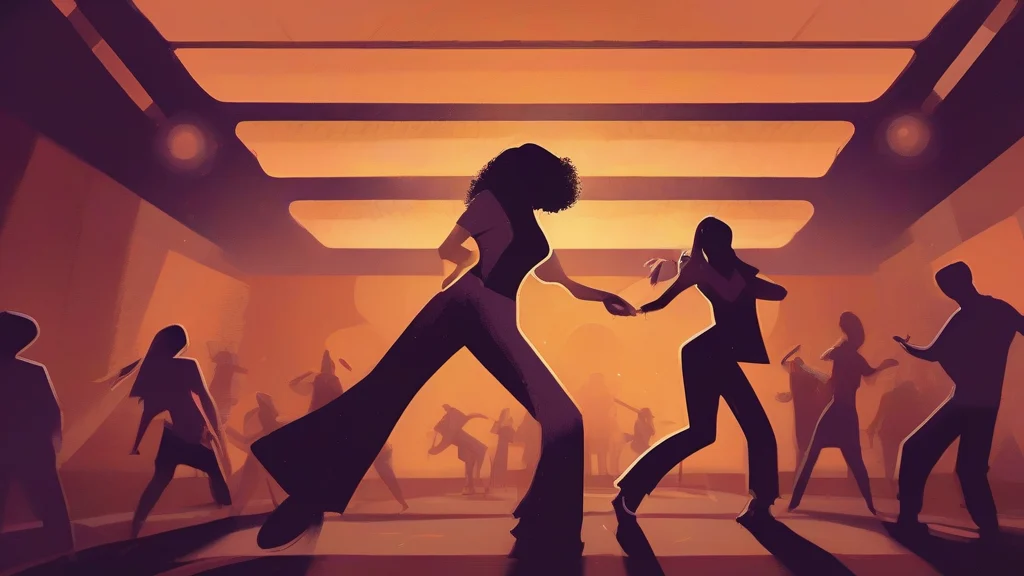
Boogie is an informal verb meaning to dance energetically, especially to upbeat popular music such as rock, funk, or disco. It emerged from African-American musical culture of the early twentieth century and is closely tied to boogie-woogie, a driving piano blues style whose repeating bass figure made listeners want to move. By the 1970s the word had become a fixture of dance floors, appearing in countless disco-era songs and giving rise to expressions like 'boogie down' and 'boogie the night away'. It also exists as a noun referring to an act of this kind of dancing, and it spawned the compound 'boogie board', a type of short bodyboard used for riding waves. The word's tone is always playful and celebratory rather than technical; nobody uses it in formal descriptions of choreography. Because of its strong association with the disco decades, using 'boogie' today often adds a touch of retro fun to a sentence, making it a vivid, evocative choice when describing lively dancing or a great night out.
To dance energetically, especially to rock, funk, or disco music.
"They boogied until the club closed at two in the morning."
Informal register; often used with adverbs like 'down' or 'away'.
An act or style of energetic dancing, especially to up-tempo popular music.
"Come on, let's do the boogie!"
Used when referring to multiple instances or styles of the dance.
"The band played all the old boogies from the seventies."
Before it meant dancing, 'boogie' was slang for moving fast — and its musical child, boogie-woogie piano, helped power rock and roll into existence.
Reviewed by Deb Chak, Editor. AI-assisted content curated by RJS Tech Solutions LLP.
Etymology of boogie
Boogie originated in early twentieth-century American English, emerging from African-American vernacular before becoming widely known through boogie-woogie, the percussive piano blues style named in the 1920s. The root may be related to earlier senses of 'booge' or 'boogie' meaning to move swiftly or to haunt, though the exact pathway is debated among etymologists. Its popularity exploded during the swing era and again in the 1970s disco boom, cementing its place in mainstream English.
Related word forms
How boogie is actually used
Register is firmly informal and playful; 'boogie' carries cheerful, party-going connotations rather than formal dance terminology. It is common in both British and American English, though it can sound retro or nostalgic because of its strong association with the disco era of the 1970s.
Easily confused with boogie
A bogie is a railway wheel assembly (or a variant spelling of 'bogey', a ghost or one stroke over par in golf), while 'boogie' means dancing energetically.