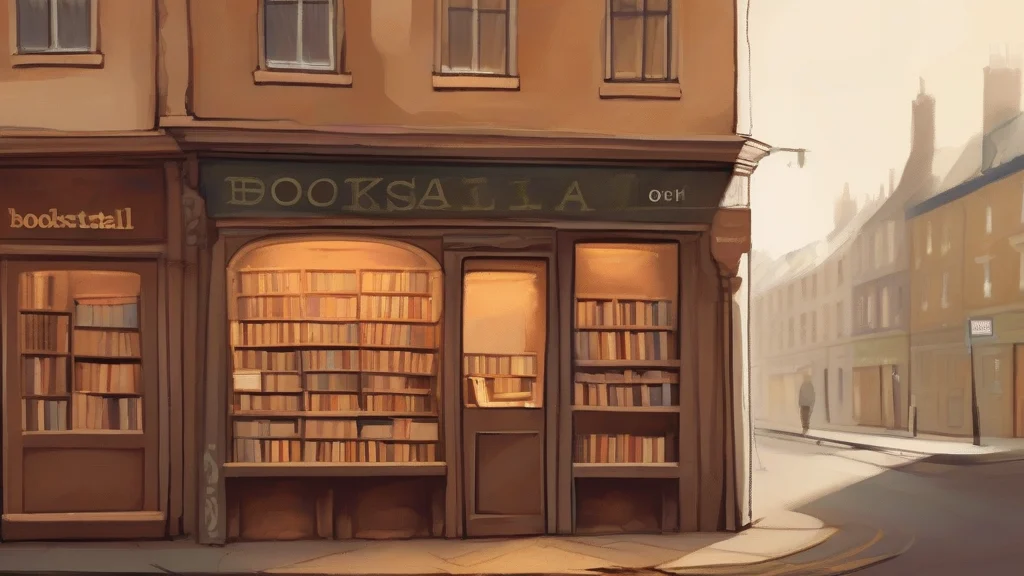
What does bookstall mean?
A bookstall is a stall or small open-fronted stand from which books are sold, most familiarly found on railway stations, in markets, or along busy streets. Unlike a full bookshop, it occupies a modest footprint and typically offers a compact selection of paperbacks, magazines, and newspapers aimed at passing trade — commuters grabbing a thriller for the journey home, or browsers hunting through second-hand volumes on a weekend market day. The word is understood throughout the English-speaking world but is distinctly British in flavour, with American English tending toward 'newsstand' or 'bookstore'. It belongs to the compound pattern of 'stall' words such as 'fruit-stall', formed by fusing 'book' with 'stall'. Today the term carries a warmly nostalgic tone: it evokes the era when station bookstall chains like W.H. Smith supplied Victorian and twentieth-century travellers with cheap reading, an image still potent even as such stalls grow rarer in the digital age.
nounA stall or small open-fronted shop where books are sold, especially one in a railway station, street, or market.
- A stall or small open-fronted stand selling books, typically at a railway station, market, or street corner.
- More broadly, a small retail outlet dealing chiefly in books and often also magazines or newspapers.
"She picked up a paperback thriller from the bookstall on Platform Four before the train pulled away."
"The bookstall at the station has been run by the same family for three generations."
"He browsed the second-hand novels piled high on the market bookstall every Saturday morning."
Regular plural; simply adds -s.
"The old station still had two bookstalls trading side by side."
For over a century, the railway bookstall — popularised by W.H. Smith's station shops in Victorian Britain — was how millions of travellers got their reading material, long before airport bookshops existed.
Reviewed by Deb Chak, Editor. AI-assisted content curated by RJS Tech Solutions LLP.
Etymology of bookstall
Bookstall is a straightforward English compound, joining 'book' — from Old English 'bōc', ultimately Germanic in origin and related to 'bēch/beech', the wood on which early inscriptions may have been carved — with 'stall', from Old English 'steall', meaning a standing place, seat, or position, later extended to mean a merchant's open booth. Both elements are native Germanic words, making this a wholly English formation rather than a borrowing from Latin or French. The compound arose naturally once itinerant and station-side bookselling became common; it became especially widespread in nineteenth-century Britain with the growth of railway travel and firms like W.H. Smith, which ran bookstalls at stations across the country. Its cognates are simply other compounds built on the same two roots, such as 'bookcase', 'booklet', 'stallholder', and 'fallstall'-type formations.
Related word forms
How bookstall is actually used
Bookstall is used in both British and American English but is noticeably more common in Britain; Americans more often say 'newsstand' or 'used bookstore' for comparable vendors. The word carries a slightly old-fashioned, nostalgic connotation today, evoking railway platforms and street markets rather than modern chain bookshops.
Easily confused with bookstall
A bookstall is a commercial stall that sells books, while a bookshelf is a piece of furniture for storing or displaying them.