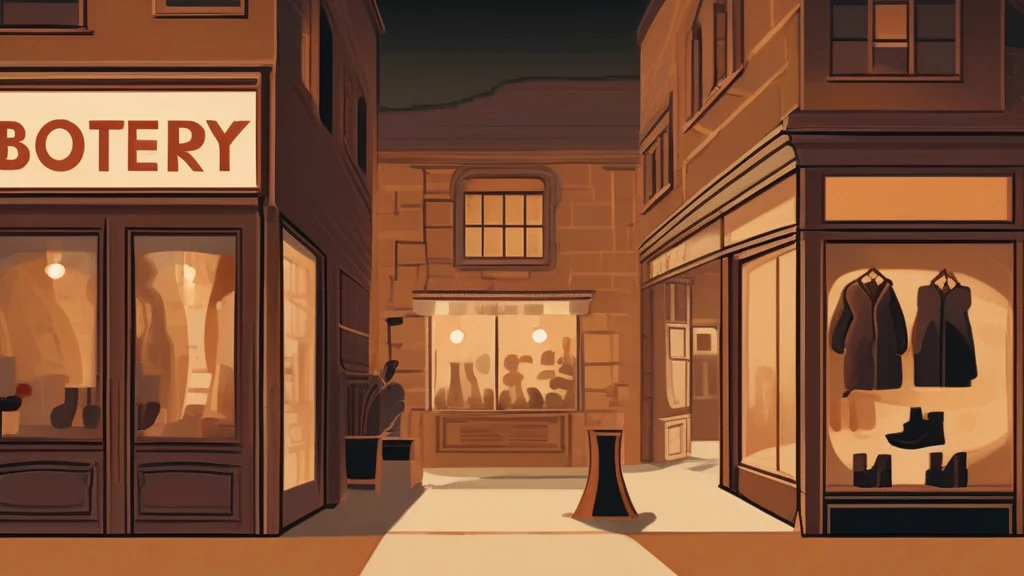
What does bootery mean?
Bootery is a now-rare English noun denoting the business or premises of a bootmaker — essentially a shop where boots are made or sold — and, by extension, boots considered collectively as merchandise. It belongs to a productive family of English words formed with the suffix '-ery' to indicate a trade, its products, or the place where they are sold, alongside terms such as hosiery, confectionery, and bakery. In practice, bootery appeared most often in nineteenth- and early twentieth-century British commercial writing, trade directories, and advertisements, where it lent a respectable air to a shoemaker's establishment. Though it has fallen out of everyday use and may puzzle modern readers, it survives as a charming piece of lexical history: encountering it today usually signals older prose or a deliberately antiquarian style. For vocabulary enthusiasts, it offers a tidy example of how English coinages once packaged entire trades into single, elegant nouns.
nounA bootmaker's establishment or shop; also, collectively, boots and footwear as articles of trade, in the manner of similar '-ery' formations such as 'hosiery' or 'confectionery'.
- The trade or business of making and selling boots; a bootmaker's shop or establishment.
- Boots or footwear regarded collectively as goods or merchandise.
"The old bootery on the corner had been fitting bespoke shoes since Victorian times."
"After the war he opened a small bootery near the market square."
"The department catalogue devoted an entire page to its winter bootery."
Pluralizes regularly when referring to multiple establishments.
"Several small booteries lined the street behind the covered market."
It rhymes with 'confectionery' and 'hosiery' — but instead of sweets or stockings, this charmingly obsolete word was all about boots.
Reviewed by Deb Chak, Editor. AI-assisted content curated by RJS Tech Solutions LLP.
Etymology of bootery
Bootery is formed from the noun 'boot' combined with the suffix '-ery', which English has long used to build words naming a trade, its wares, or its place of business. The pattern follows well-established formations such as hosiery, confectionery, and bakery. The word arose in English, apparently in commercial contexts, with its recorded use concentrated in the eighteenth and nineteenth centuries; precise first attestation is uncertain, so no exact date should be claimed. Its cognates are not foreign borrowings but sibling English '-ery' derivatives sharing the same suffix.
How bootery is actually used
Rare and largely historical; found chiefly in older British writing and trade directories. It carries a quaint, period flavor and would strike modern readers as archaic.
Easily confused with bootery
'Booty' means plunder or treasure taken in war (or slang for treasure generally), whereas 'bootery' refers to a bootmaker's trade or shop.