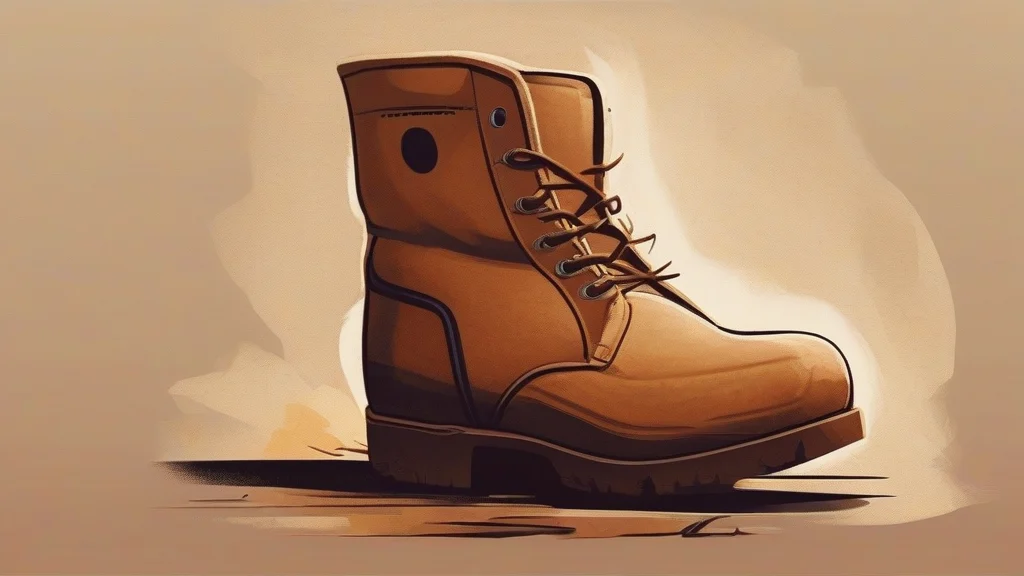
What does boot mean?
A boot is a type of footwear that covers not just the foot but also the ankle, and often much of the leg, typically made of leather, rubber, or another durable material. Boots are associated with protection and practicality — work boots, hiking boots, and Wellington boots all serve protective purposes — though they are equally a fixture of fashion. In British English, boot carries a second everyday meaning: the enclosed luggage compartment at the rear of a car, what Americans call the trunk. Informally, 'the boot' signifies dismissal, as in being given the boot, and as a verb boot can mean to kick or, in computing, to start a machine ('boot up'), a term descended from the old expression 'to pull oneself up by one's bootstraps'. A curious relic, the phrase 'to boot', meaning 'in addition', comes from an unrelated Old English word for profit or remedy. Few common nouns pack so many distinct senses into so short a form.
A sturdy item of footwear covering the foot and ankle or extending up the leg.
"The soldiers polished their black boots until they shone."
(British English) The storage compartment at the rear of a car.
"She loaded the shopping into the boot of the car."
American English uses 'trunk' for this sense.
To kick something or someone forcefully; informally, to eject or dismiss someone.
"He booted the ball clear of the penalty area."
(Computing) To start a computer and load its operating system, usually phrased as 'boot up'.
"Reboot your laptop if the program freezes."
Regular plural. Often used in the plural even when referring to the pair worn on both feet.
"He left his muddy boots by the door."
"To boot" — meaning 'in addition' — comes from an entirely different Old English word meaning profit or remedy, making English home to two unrelated boots.
Reviewed by Deb Chak, Editor. AI-assisted content curated by RJS Tech Solutions LLP.
Etymology of boot
The word boot entered Middle English from Old French bote or bott, which itself appears to derive from an unattested Germanic source, though the precise ultimate origin remains uncertain. It has been part of English since at least the early fourteenth century, originally denoting a protective covering for the leg. Its Romance-Germanic hybrid path gave it cognates such as modern French botte. Separately, the idiom 'to boot' preserves an older, unrelated Old English noun bōt meaning profit, remedy, or compensation.
Related word forms
How boot is actually used
The word spans registers comfortably: everyday and neutral when referring to footwear, informal in expressions like 'give someone the boot'. The car-trunk sense is distinctly British — American speakers say 'trunk' — while the computing sense ('boot up') derives from the phrase 'pull oneself up by one's bootstraps' and is universal in technical usage.
Easily confused with boot
Boot rhymes with boat but differs in vowel: boot has the long /uː/ of 'shoot', while boat has the diphthong /oʊ/.