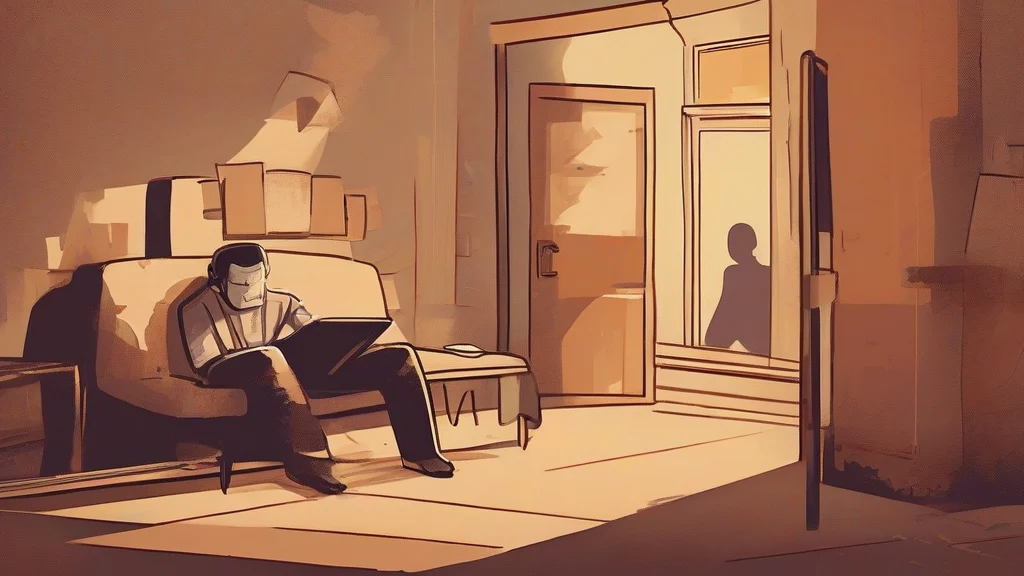
What does bored mean?
Bored describes the restless, weary state of someone who has nothing engaging to occupy their attention — the flat, impatient feeling of sitting through a dull meeting, a slow afternoon, or a conversation going nowhere. It functions chiefly as an adjective and as the past participle of the verb 'bore', which means to tire by being dull. The word carries a mildly negative connotation but is entirely neutral in register, appearing equally in casual speech and formal writing. English speakers reach for vivid intensifiers when ordinary 'bored' feels insufficient: bored stiff, bored rigid, bored to tears, bored out of one's mind. A useful distinction governs its use: people feel bored, while things are boring. So a lecture can be boring while its audience is bored — a difference learners often mix up. Related forms include the noun 'boredom' and the adjective 'boring'.
Weary and impatient because one is unoccupied or lacks interest in what one is doing.
"By the second act she was thoroughly bored."
Usually predicative; intensified colloquially as 'bored stiff' or 'bored to tears'.
Past tense and past participle of 'bore': to make (someone) weary and uninterested through dullness.
"The speaker bored the audience with forty minutes of statistics."
Used transitively; compare the -ing/-ed distinction: the talk was boring, so the listeners were bored.
No one is quite sure where the word 'bore' itself came from — it appeared out of nowhere in the 18th century, as if even its own history found it dull.
Reviewed by Deb Chak, Editor. AI-assisted content curated by RJS Tech Solutions LLP.
Etymology of bored
Bored derives from the verb 'bore', meaning to weary with tedium, which first appears in English in the mid-18th century. Its ultimate origin remains genuinely uncertain — no secure cognate has been identified in other languages, though some have speculated links to French or to an earlier sense of 'bore'. The participial form 'bored' quickly established itself as the standard adjective for the state of being wearied by dullness, alongside the derived nouns 'boredom' and 'boring'.
Related word forms
How bored is actually used
Predominantly used predicatively ('I am bored') rather than attributively ('a bored person' is fine but less common than 'a boring film' for things that cause the feeling). Informal intensifiers like 'bored stiff', 'bored rigid', and 'bored to death/to tears' are common in speech.
Easily confused with bored
'Board' refers to a flat piece of wood, a group in charge, or to get on a vehicle, whereas 'bored' means feeling uninterested and weary.