
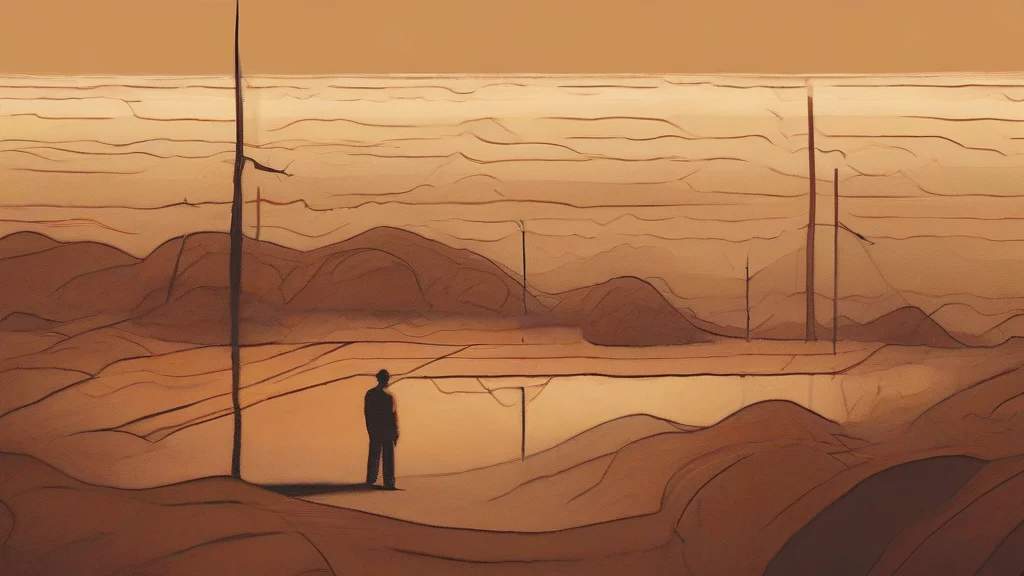
What does bottomlessness mean?
Bottomlessness is a noun meaning the quality of having no bottom, lower limit, or final depth. Its literal use evokes an abyss, an ocean trench, or a darkness so deep that no floor can be perceived. Far more often, however, the word is figurative: it describes emotions, desires, mysteries, or forms of corruption that seem impossible to measure or satisfy. The phrase “a sense of bottomlessness,” for instance, can describe awe, dread, grief, or spiritual wonder, while references to the bottomlessness of greed often suggest an appetite that can never be filled. The word is especially effective in literary and philosophical writing because it combines a physical idea, the absence of a visible base, with the broader concept of limitlessness. Its uncommon and vivid character makes it useful for expressing depth that ordinary language such as “depth” or “limitlessness” may not convey with the same force.
nounThe state or quality of being bottomless, especially of having no discernible lower limit or depth. Figuratively, it refers to something vast, unfathomable, or seemingly limitless, such as the depths of the ocean, human desire, or moral corruption.
- The state of having no bottom or lower limit, especially when describing an expanse of water or a physical void.
- The quality of being vast, unfathomable, or seemingly limitless, especially when applied to emotions, desires, darkness, or moral corruption.
"The divers tried to convey the terrifying bottomlessness of the ocean trench."
"The lighthouse beam exposed only fragments of the sea's bottomlessness."
"She was drawn to the bottomlessness of the mystery surrounding her family's past."
Rare; bottomlessness is normally used as an uncountable abstract noun, as in “a sense of bottomlessness.”
"The novel explores different bottomlessnesses of grief and memory."
To call something bottomless is to imagine a descent that never reaches a final floor.
Reviewed by Deb Chak, Editor. AI-assisted content curated by RJS Tech Solutions LLP.
Where does bottomlessness come from?
Bottomlessness is an English formation combining bottom with the suffix -less. The word bottom descends from Old English botm, referring to the lowest part or base, while -less comes from Old English -lēas, meaning “without” or “free from.” The resulting noun names the quality of being without a bottom or limit, and related forms include bottomless, bottomed, and bottoming.
How bottomlessness is actually used
This is an abstract noun used mainly in literary, philosophical, religious, and descriptive contexts. It often has a strongly dramatic or ominous tone, especially when referring to the sea, the unconscious, human desire, or moral evil. It is less common in practical or everyday speech than the related adjective bottomless.
Easily confused with bottomlessness
Bottomlessness is the noun naming the quality of having no bottom, whereas bottomless is the adjective describing something that has no bottom.