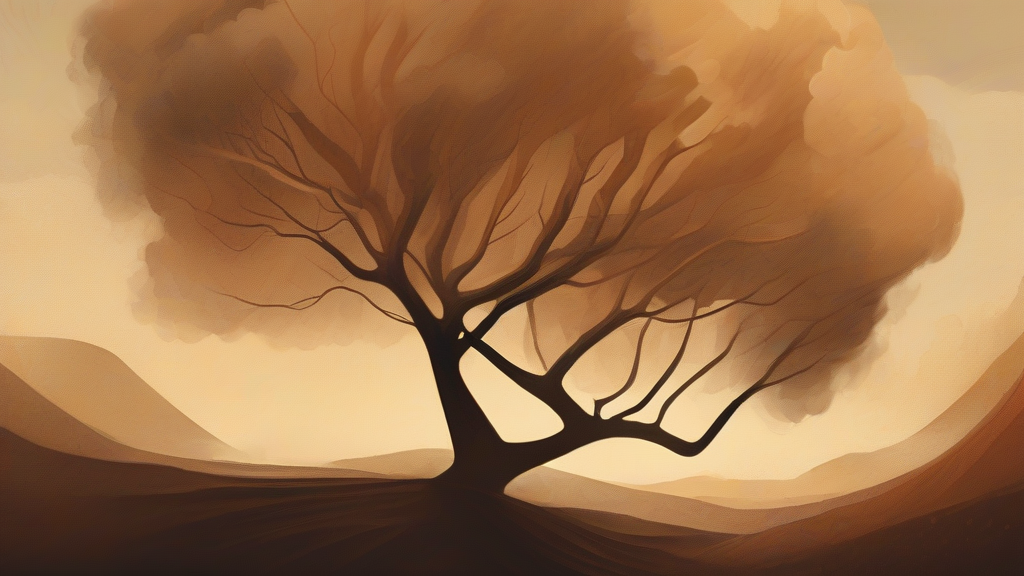
What does boughed mean?
Boughed is an adjective describing a tree or plant that has boughs — that is, large main branches — particularly when those branches are abundant, heavy, or otherwise striking. A writer might describe an ancient oak as 'gnarled and thickly boughed' to convey its imposing spread, or refer to a 'low-boughed' pine whose branches hang within easy reach. The word derives from 'bough,' an Old English term for a tree's arm-like limbs, and it carries a distinctly literary flavor: it appears most often in nature writing, pastoral description, and poetic prose rather than casual conversation. Because it so closely resembles 'bowed' in spelling, careful readers should note the difference — one word concerns curvature or bending, the other branching. Though rare, boughed offers writers a precise, evocative way to characterize the architecture of a tree.
adjectiveHaving boughs or branches; covered or furnished with tree branches. Used chiefly to describe trees that are heavily or notably branched.
- (Of a tree) Having boughs or branches, especially numerous or heavy ones.
"The old oak, gnarled and thickly boughed, shaded half the meadow."
"The apple orchard's oldest tree stood broad and well boughed at the summit of the hill."
"They strung lanterns among the low-boughed pines for the evening celebration."
Despite looking like a typo of 'bowed,' boughed has graced English since the days of Old English poetry — it's what you call a tree too grand and branch-laden for any simpler word.
Reviewed by Deb Chak, Editor. AI-assisted content curated by RJS Tech Solutions LLP.
Etymology of boughed
Boughed is formed from 'bough,' which descends from the Old English 'bōg' or 'bōh,' meaning a shoulder or arm, later specialized to mean the limb or branch of a tree. The same Germanic root gave rise to related words such as 'bow' and 'elbow.' As a participial adjective built on this noun, boughed has long served English writers who needed a compact way to say 'furnished with branches.'
How boughed is actually used
A literary and somewhat rare word, found mostly in descriptive or poetic prose. It typically appears attributively in compounds like 'low-boughed' or 'thickly boughed' rather than standing alone. Not common in everyday speech.
Easily confused with boughed
'Bowed' (from 'bow') means bent or curved, and can be pronounced either /boʊd/ or /baʊd/, whereas 'boughed' always refers to having branches.
'Bought' is the past tense of 'buy', while 'boughed' relates to tree boughs; they differ in both meaning and pronunciation (/bɔːt/ vs /baʊd/).